Leaving Bilbao April 21

Easter is over and it is time for us to get off the Camino Del Notre path and head up into the Picos de Europa.

In addition to its famous hiking paths, this area is known for its alpine flowers and wild orchids.

We will spend the next week scrambling over the rocks and looking for horticultural treasures.

But before we leave, a couple of parting thoughts about Bilbao.

There is much to see in this small city. If you are walking the Camino Del Norte, it is the perfect place for a rest day.

If you are able stay longer, there is plenty to keep you busy for three days.

What do see.

There are enough churches to go on an endless “church crawl”.

Getting into these churches can be a challenge as most are only open certain hours each day.

Spaniards take their siesta time very seriously and the clergy are no exception. ( On one of our earliest caminos, we stayed in a convent. We were sent outside from 2-4 so the nuns could have their siesta.

We slept outside on park benches while they slept inside. Promptly at 4 the doors opened and we were welcomed back in. (TRUE STORY!)

But back to the churches. The Cathedral of Santiago is impressive and the audio guide is excellent.

With a Pilgrim passport, your entry is free.

The churches of San Juanes, San Anton and San Nicholas are all different and have interesting interiors.

Ironically during Holy Week most of them were locked.

However since the “liturgy” took place on the street it didn’t matter except I have no pictures to show of the churches themselves.

The Guggenheim Museum, at least the outside, is a must see. Although it is now more than twenty years old it still looks, well, modern and fresh.
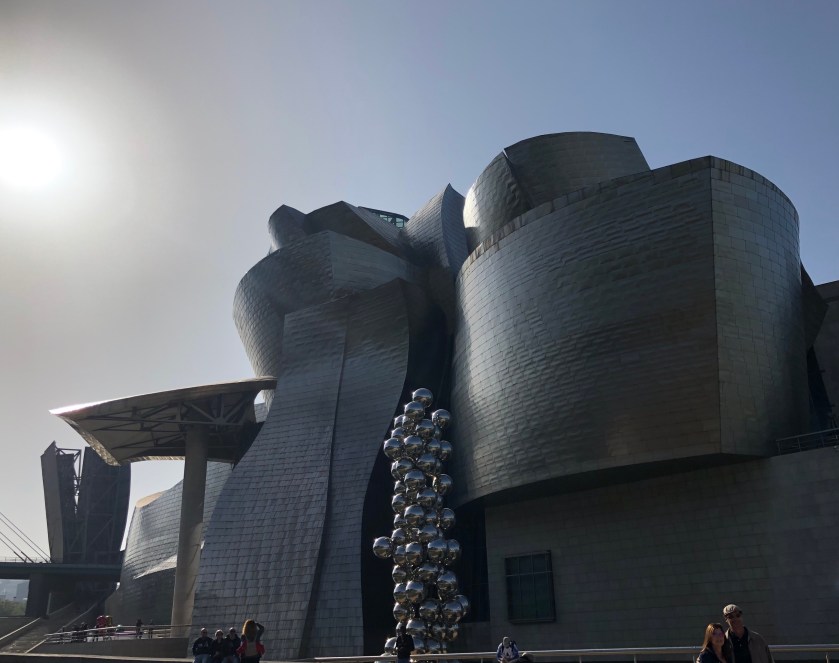
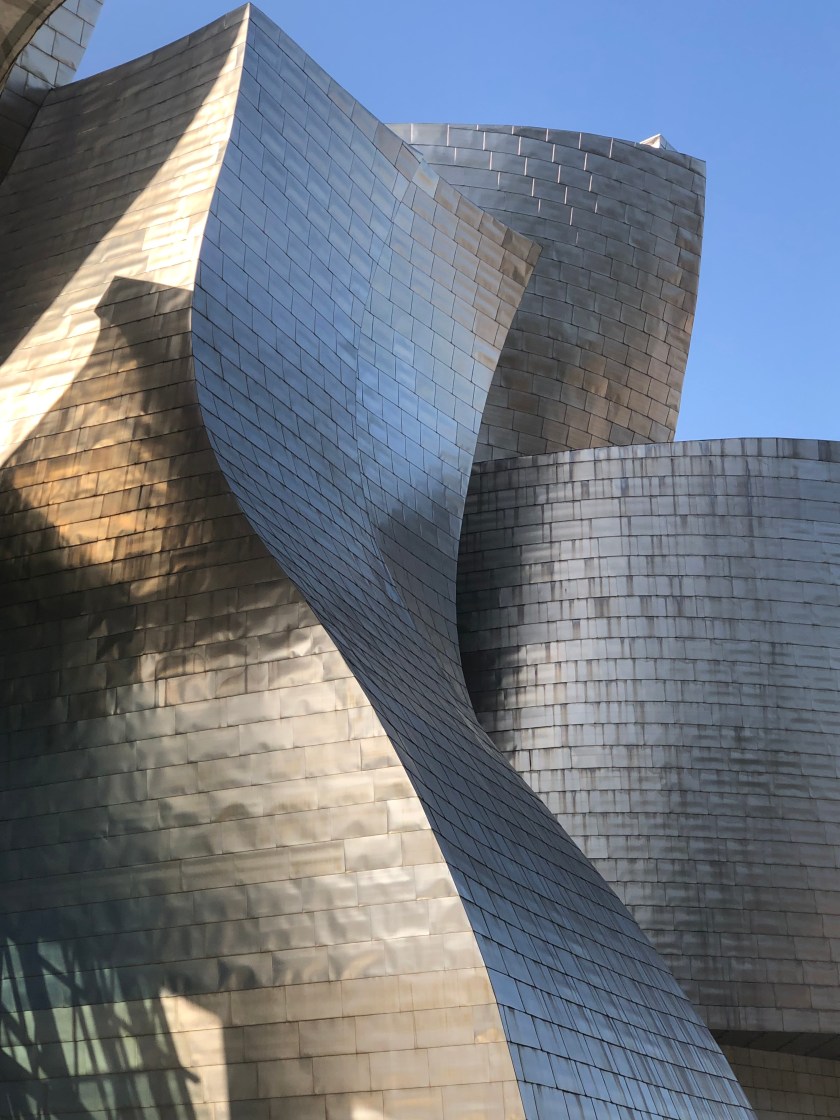
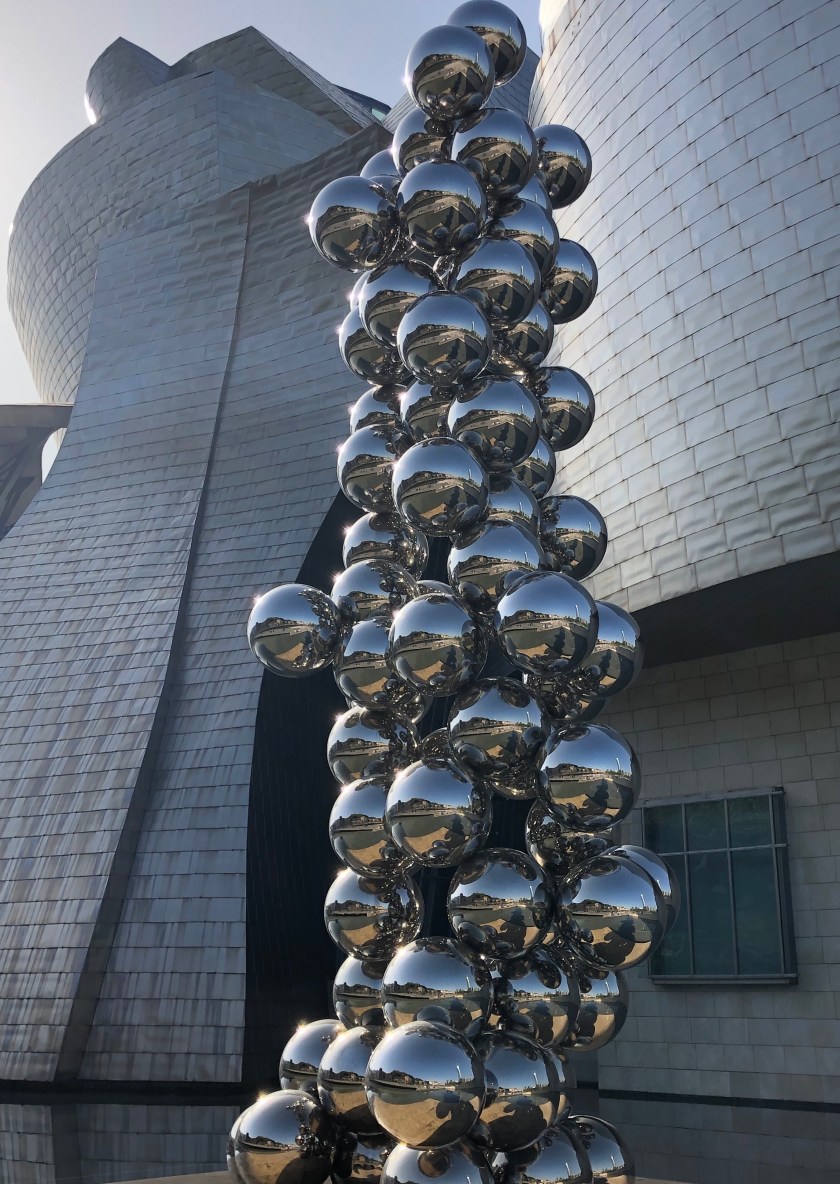
The exterior sculptures are great.

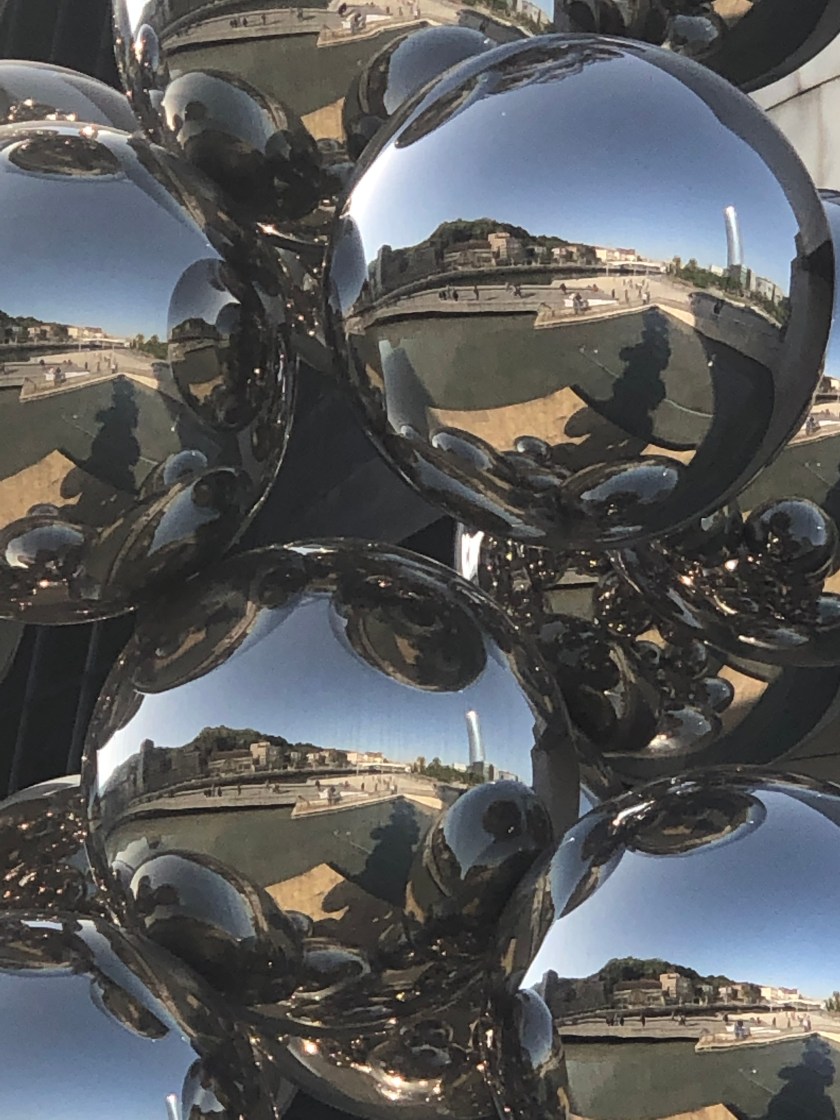
Tall tree and The Eye by Anish Kapoor is a series of stainless steel reflective balls randomly stacked, each ball reflecting its neighbor and the scenery around it.
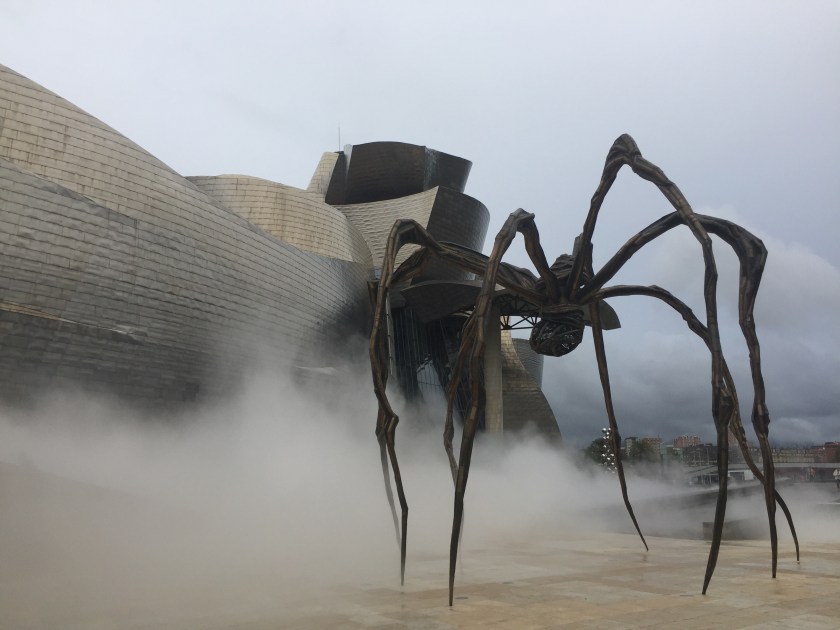
The bronze sculpture entitled Maman by artist Louise Bougeois is impressive especially when you stand underneath and look up into the sack of eggs under her body. The periodic fog outbursts add to the experience.
On the other side of the museum is the “flower dog” or officially Puppy by Jeff Koons.

I love this statue. It is 150 feet tall and weighs about 16 tons.
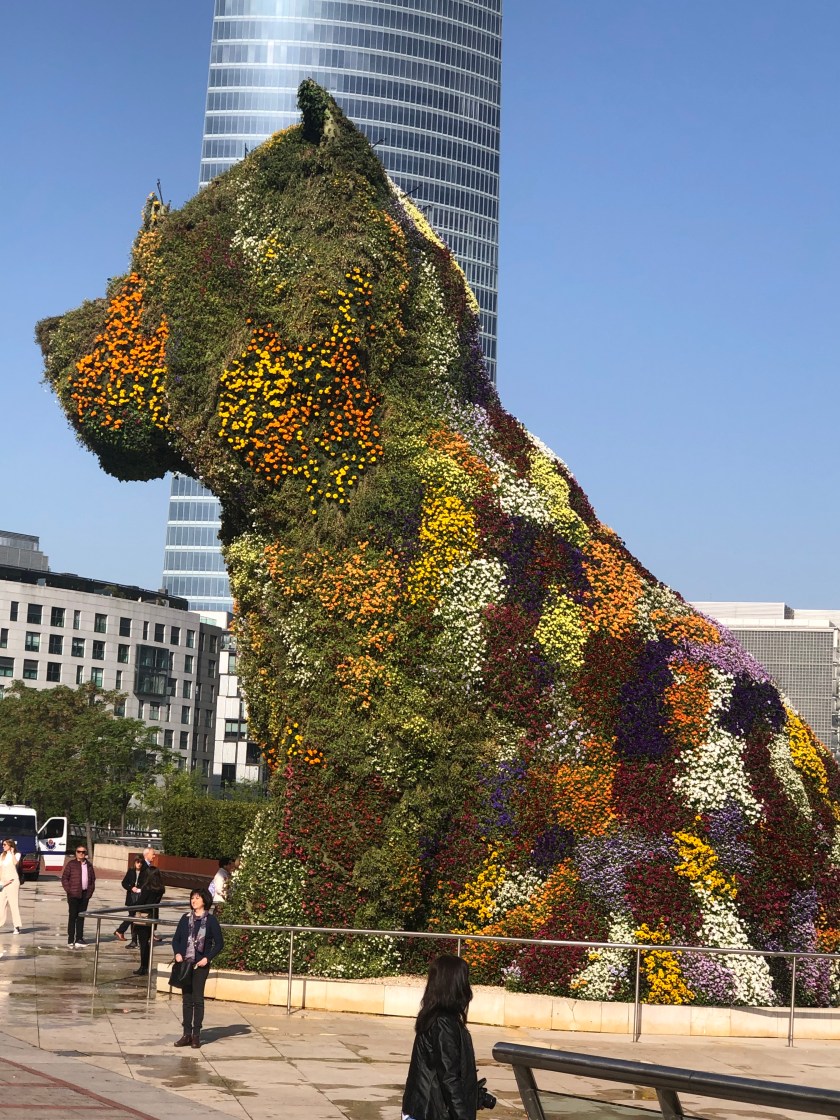
It is covered with flowers which are changed twice a year, 37,000 plants in all.

We are here at the end of the Oct- May installment of pansies and the flowers looked fantastic.
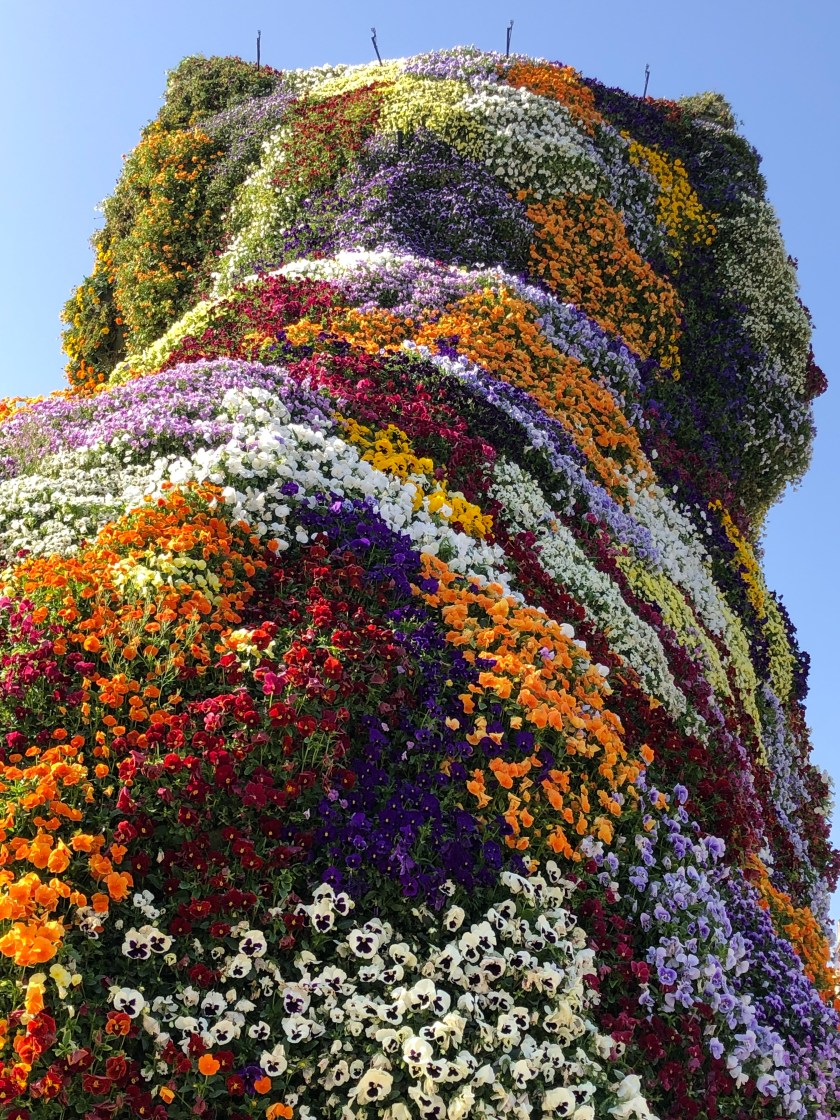
The steel frame onto which multi colored pansies have been set in peat, utilizes an internal watering system that includes weekly fertilizing. This may be explain why they look so healthy.
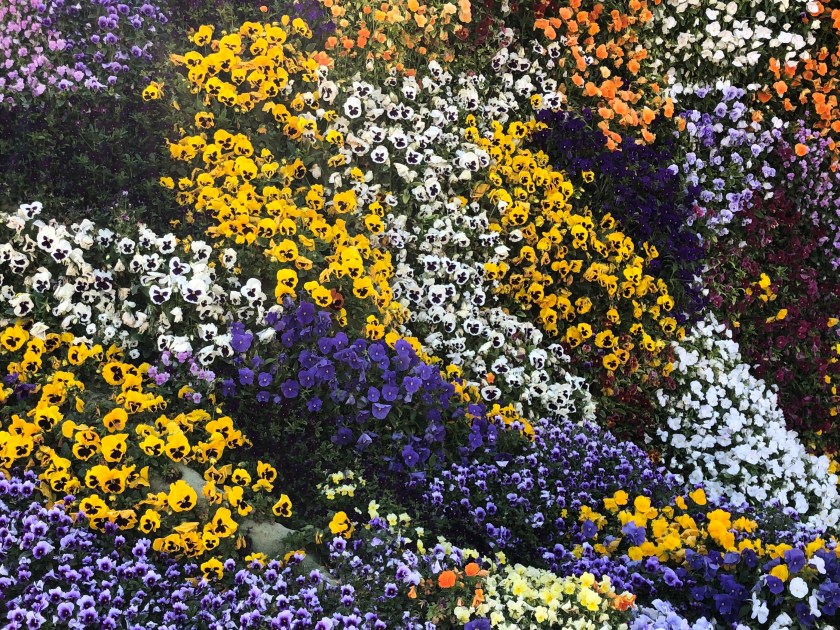
To change the flowers takes 30 gardeners working one week.

Happily this will not occur until we have left.

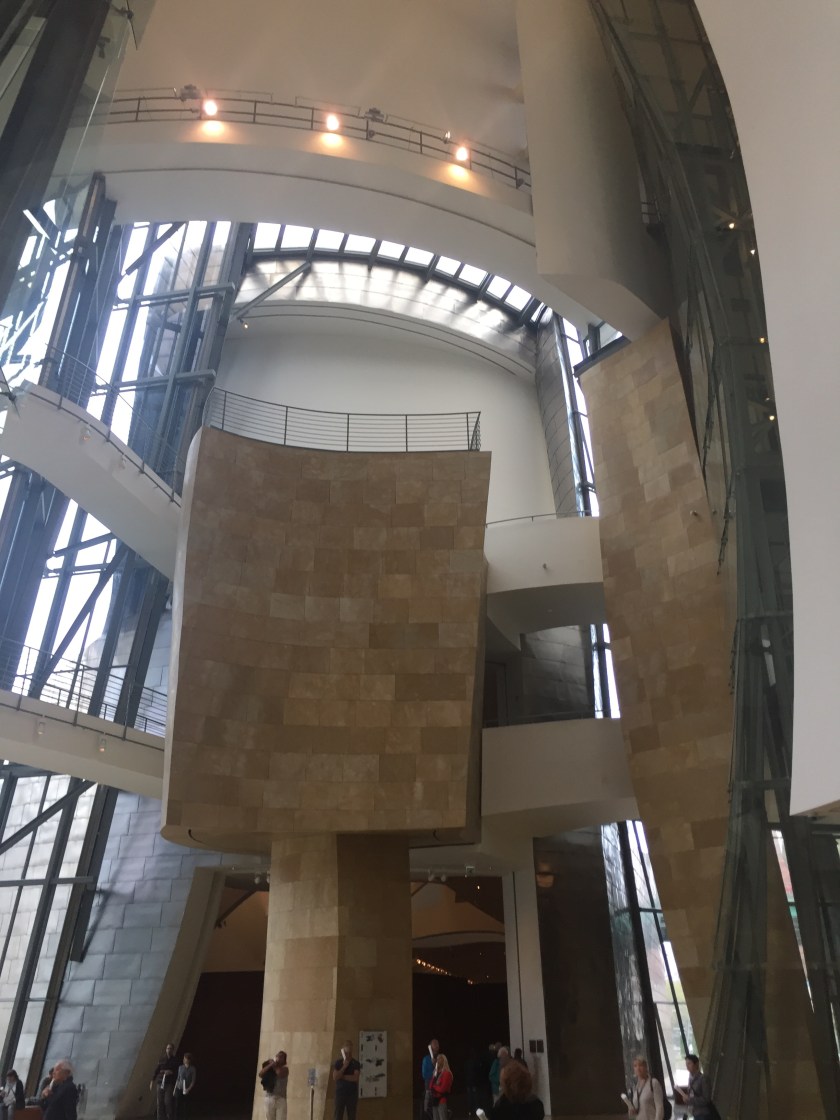
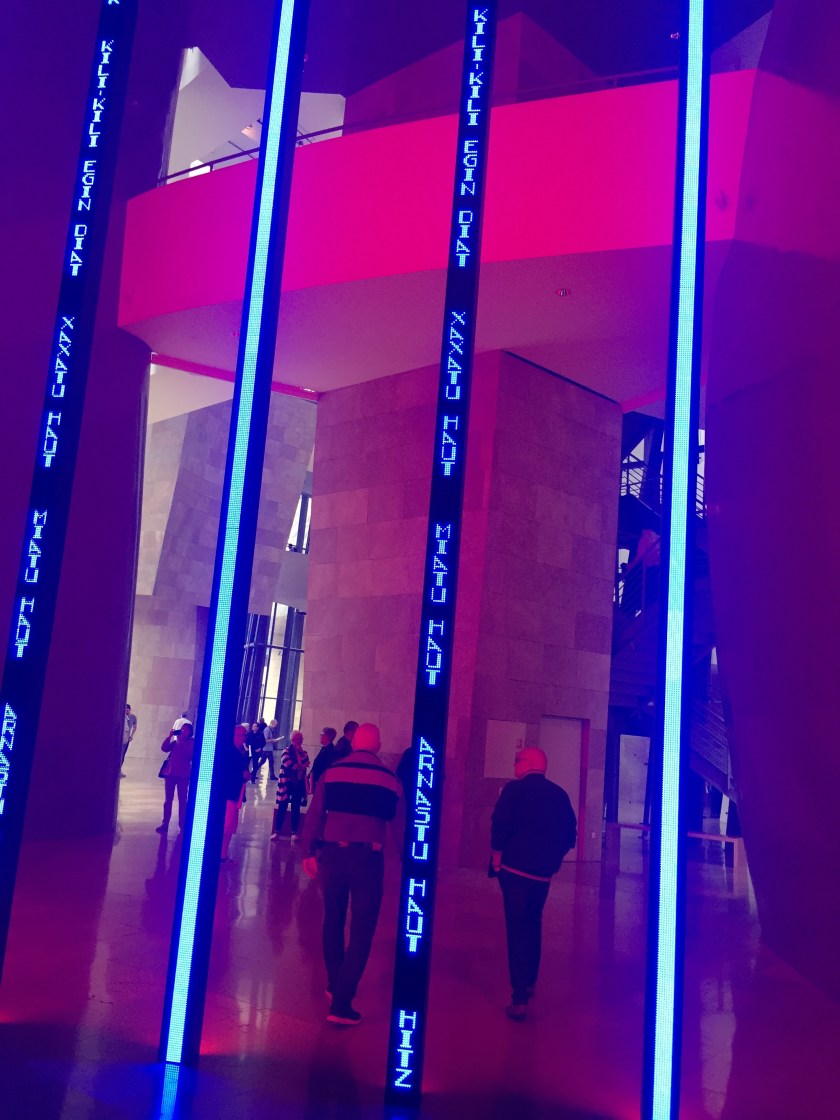
The interior of the museum is another matter. I just don’t get it.

Maybe I am too old; maybe I am not modern enough. Bottom line. Check it out and decide for yourself.
Portugalete is a suburb west of Bilbao at the mouth of the Estuary of Bilbao which opens into the Bay of Biscay. You will pass through this town on the Camino as you walk back to the coast.

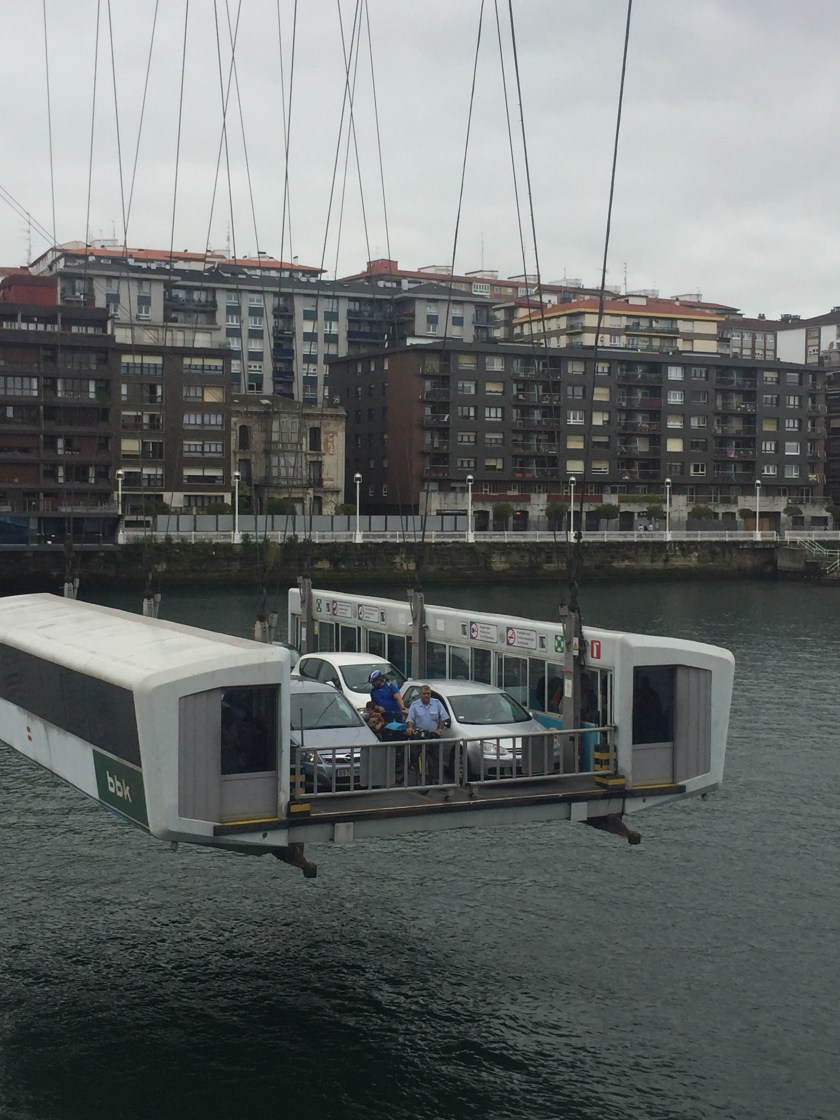
It is well worth stopping to see the historic Transporter Bridge.

Built in 1893, this hanging bridge/ ferry is able to carry six cars and several dozen pedestrians across the river. It was been in continuous use except for a brief suspension ( bad pun) after it was bombed during the Spanish Civil War.
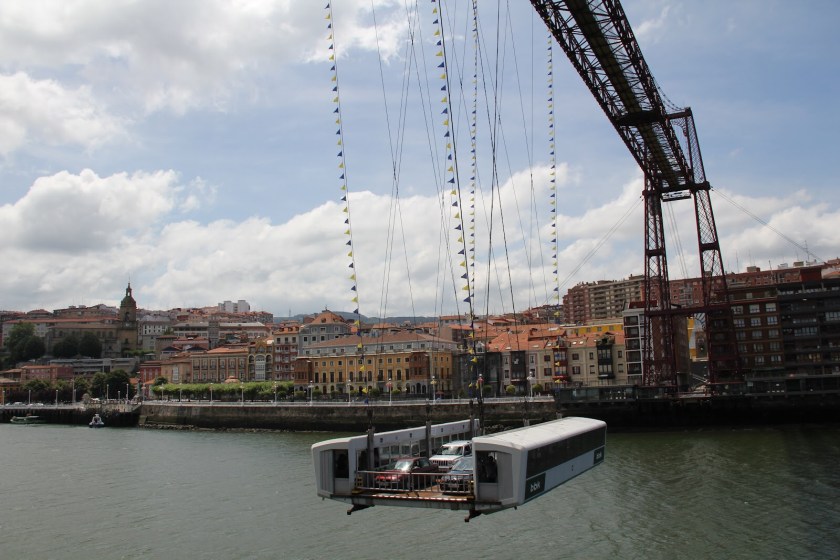
It is now possible to have a round trip adventure.

Take the elevator to the top of the support leg and walk across the pedestrian boardwalk. Enjoy the views around and underneath you.

I prefer looking out to looking down but it is quite something to watch the ferry pass beneath you.
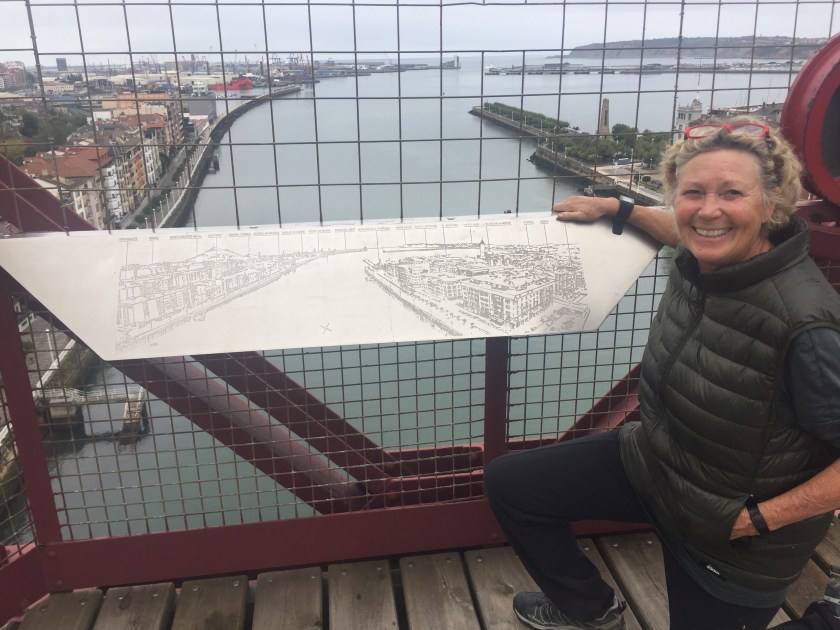
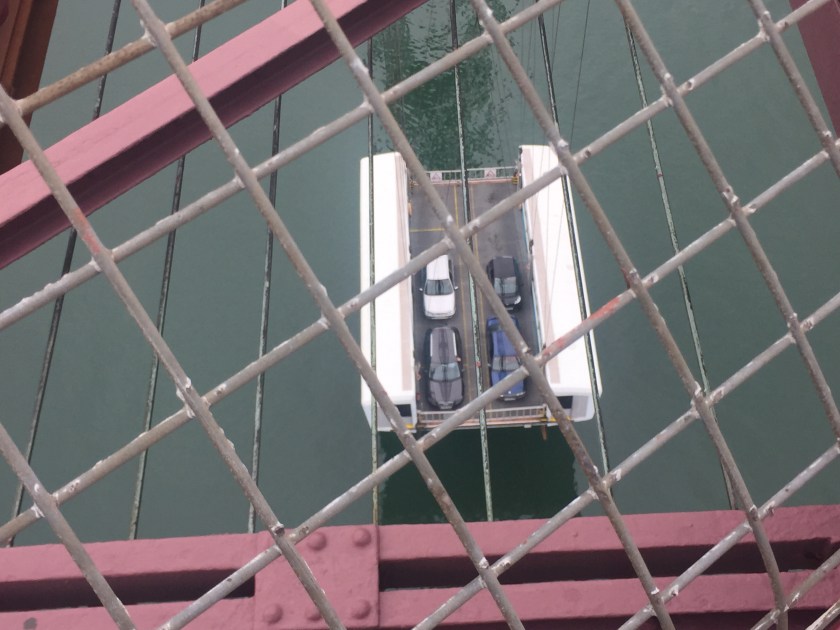
It takes a little courage to walk the boardwalk, but this daring feat of bravado is well worth the quivering knees and sweaty palms.

Besides when you come down, you feel quite snug and have surely earned at least one glass of wine. All good.

And so we leave Bilbao behind us.

It is time for us to pick up a car and drive into the mountains. Stay tuned for our adventures of single track driving and mountain goat walking.
Holy Week – Easter Eve

I had not quite figured out how I was going to get to church on Easter Day.

We had to be out of our hotel by noon and we were due to pick up our car at the Bilbao airport at the same time.

Finding any kind of a schedule for Easter at any church had been unsuccessful.

Tranquila Senora. It will work out. It always does.

As Mick Jagger says, ” You don’t always get what you want but you’ll find, you usually get what you need.

B and I had an early dinner Saturday and were in for the night when I heard drums and brass and the familiar sounds of a Holy Week Procession. But our neighborhood was not on any procession schedule.

The night was young and truth to tell, I really needed a piece of chocolate. I knew the store down the block was open late. Late. It was eight o clock.

Snap decision. Clothes on. Head out to find the procession. Worst case. Get chocolate and go back to bed.

I wandered around the side streets and finally gave up and headed back to the hotel.

I passed the church in our neighborhood and the gates which had been locked all week, were open. So I went in.

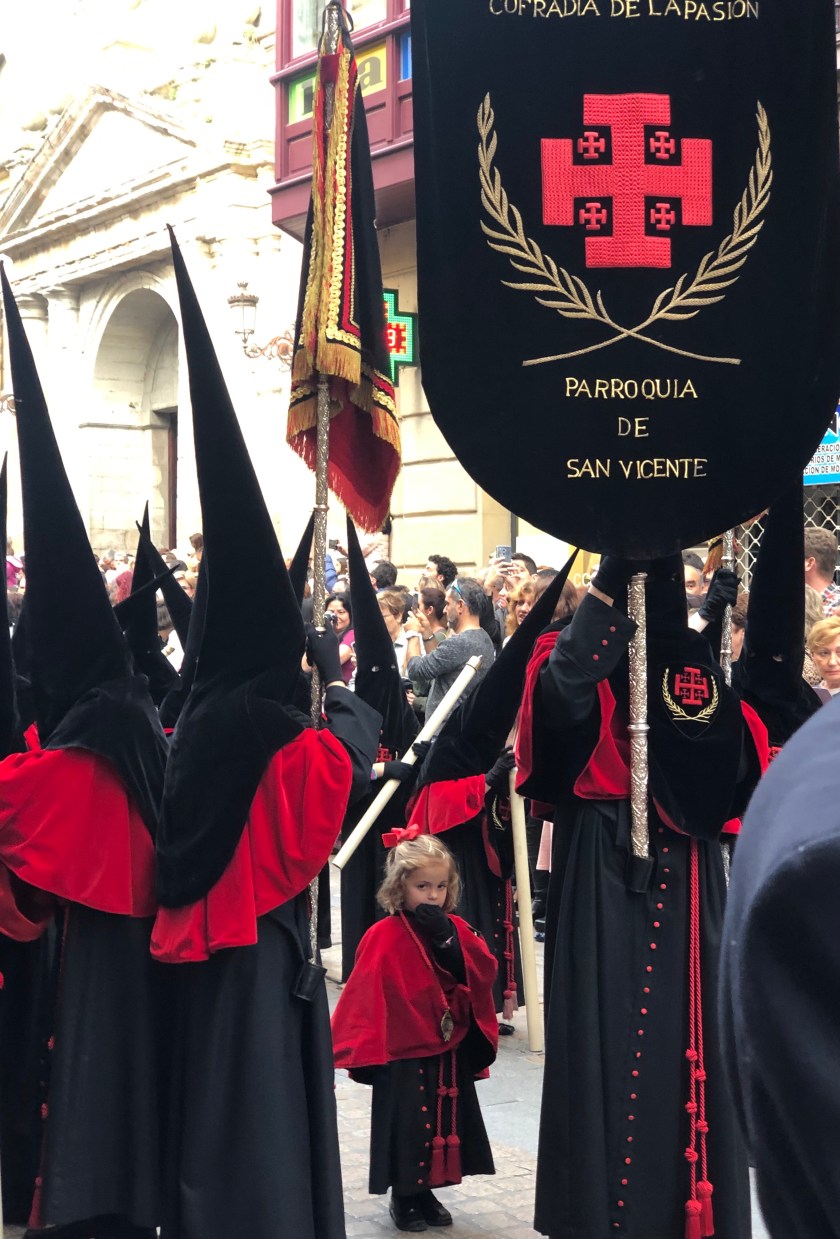
I did not know the name of the church but I recognized the banners from the Good Friday Procession.

I was in the parish church of Saint Vincent and the Easter Vigil had just begun.

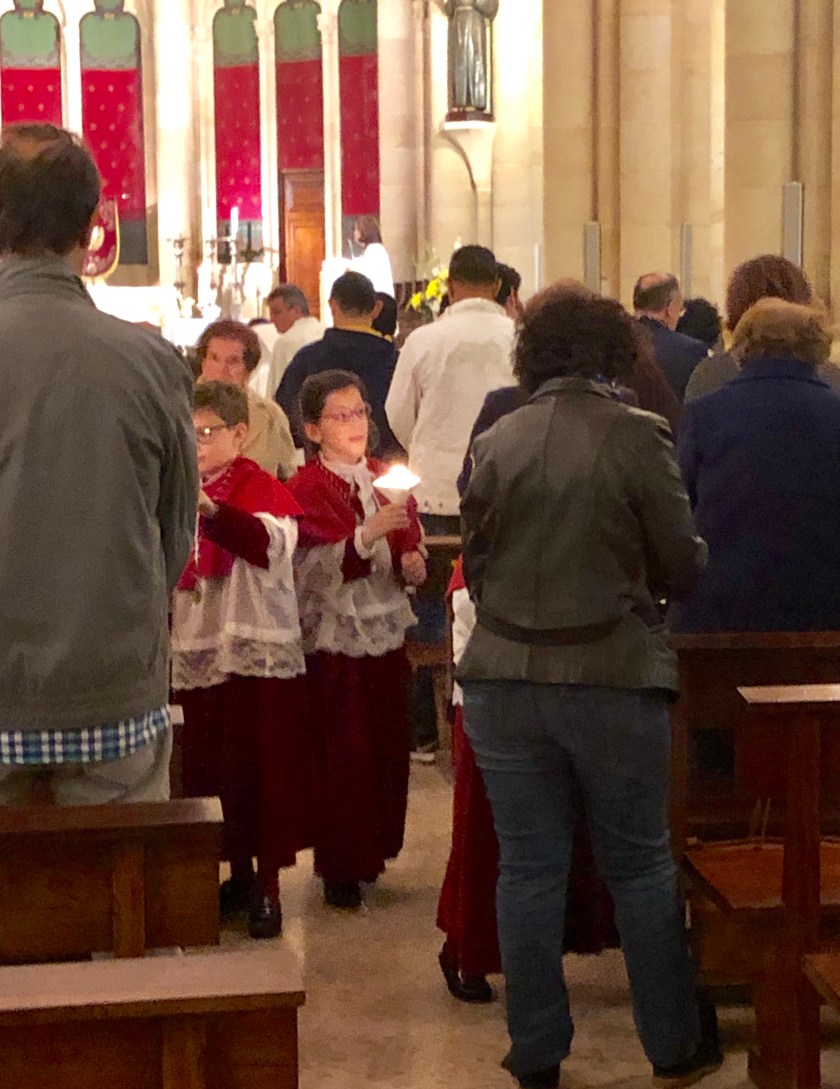
A man, who I assumed was an usher, stopped me from going too far down the center aisle. I took a seat near the back just in time for a group of children to begin working their way through the congregation to light the vigil candles.

I asked the “usher” where I could find the candles. No candles, he motioned. Ok, no candle.

As the children worked their way to the back of the church I recognized them as children who had been in the Procession the night before.

I notice my usher friend has found more candles for the people behind me.

Now here is an interesting question.

If you are a stranger and alone, how exactly does this make you feel?

Are candles only for the parishioners? Do you have to buy them? What is the drill?

Are you being overly sensitive? Does it really matter? Is this how the church really is? Why do you care so much about a candle?

I have no answers but I can tell you this. I have rarely felt as alone as I felt at that moment.

My usher pal is now sitting opposite me and he knows the service inside and out. He also has a beautiful voice and sings with great enthusiasm. He is also wearing black shoes. He can’t fool me; he is a priest!

The traditional Easter Eve liturgy proceeds with members of the Fraternity reading the lessons. I can’t make out all of them but they do include the Exaltation, the Dry Bones and the Red Sea readings.

We move onto the sermon. The priest begins with these words. “Jesus is alive!”

In his sermon of about six minutes, he repeats this phrase over and over. No doubt what his message is. As we say in the family. ” He got Jesus out of the tomb!”

No apologies, no politics, no slipping and sliding. Take it or leave it, but this is what Easter is about. Believe it or don’t believe it, but I believe it and you should too .

He ends his sermon with these words “Jesus is alive; Christ is risen!”

Suddenly, I am not alone any more and I don’t need a candle to be a part of this family.

Before the Peace, the children are back to relight the candles.

Silently the usher/priest reaches across the aisle and puts a candle in my hand. I am not a stranger anymore and I am undone.

On to the peace.

Political correctness has not made it to this parish. At the peace, the priest gives every single person in the church (and there are lots) a kiss on both checks and often a hug. This shepherd knows his sheep and they know him.

I guess I look like one of his sheep as I get the same two kisses and a hug.

My usher/priest crosses the aisle and embraces me with a kiss on each check. We both cry.

The peace takes a long time but the music by the choir is wonderful.

I am stunned to discover at communion there are only about eight choir members. I think they have some surround sound amplification as I would have sworn there were 30 or 40 people singing. Maybe the angelic choirs were helping out!

Before the priest begins the consecration he invites all of the children to join him around the altar. About 35 children surround him and are completely drawn into the liturgy. The future of the church celebrates the Resurrection together.

When I go up to communion, it all makes sense.

The various parish guilds from the Good Friday procession are all seated together in the front section of the church.

Their drums and brass instruments and banners line both sides of the church. They were the call to worship I heard from my hotel room.

And so the Easter Vigil ends. I feel like I have known these people all my life. Lots of hugs , more kisses, a final embrace from my usher/priest/friend.

As I walk out the door I see a statue from one of the Good Friday floats.

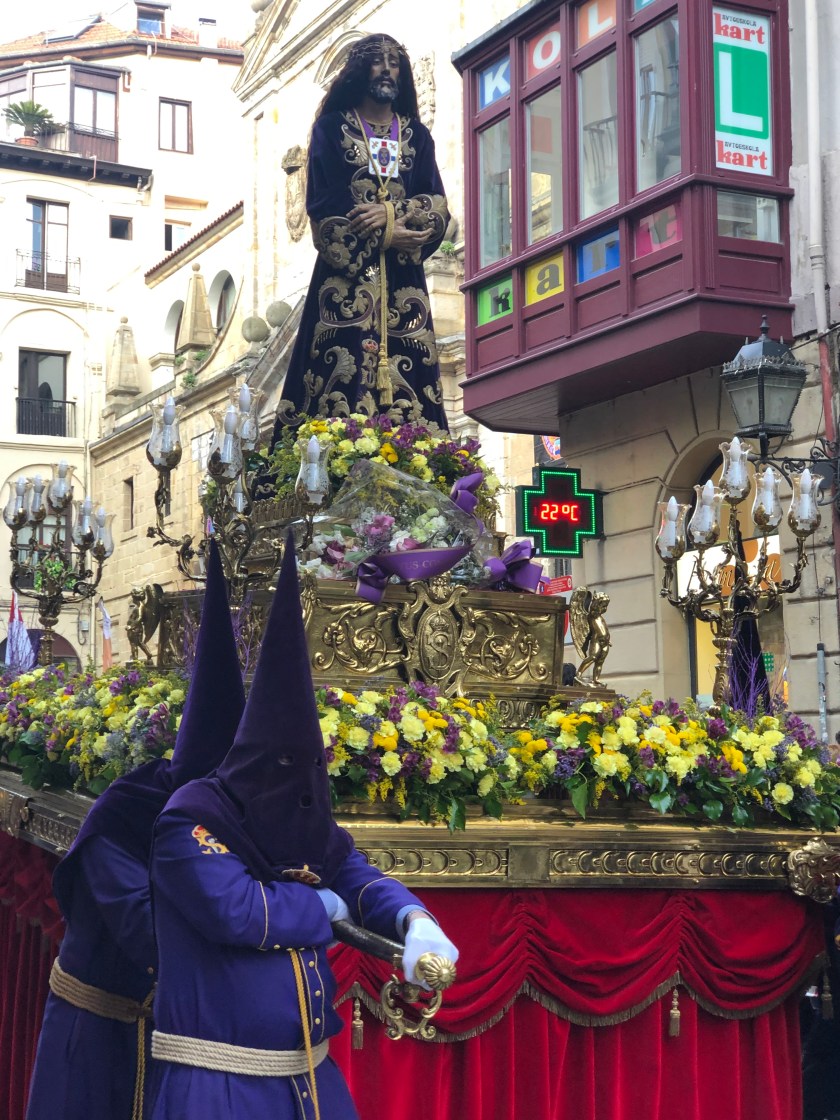
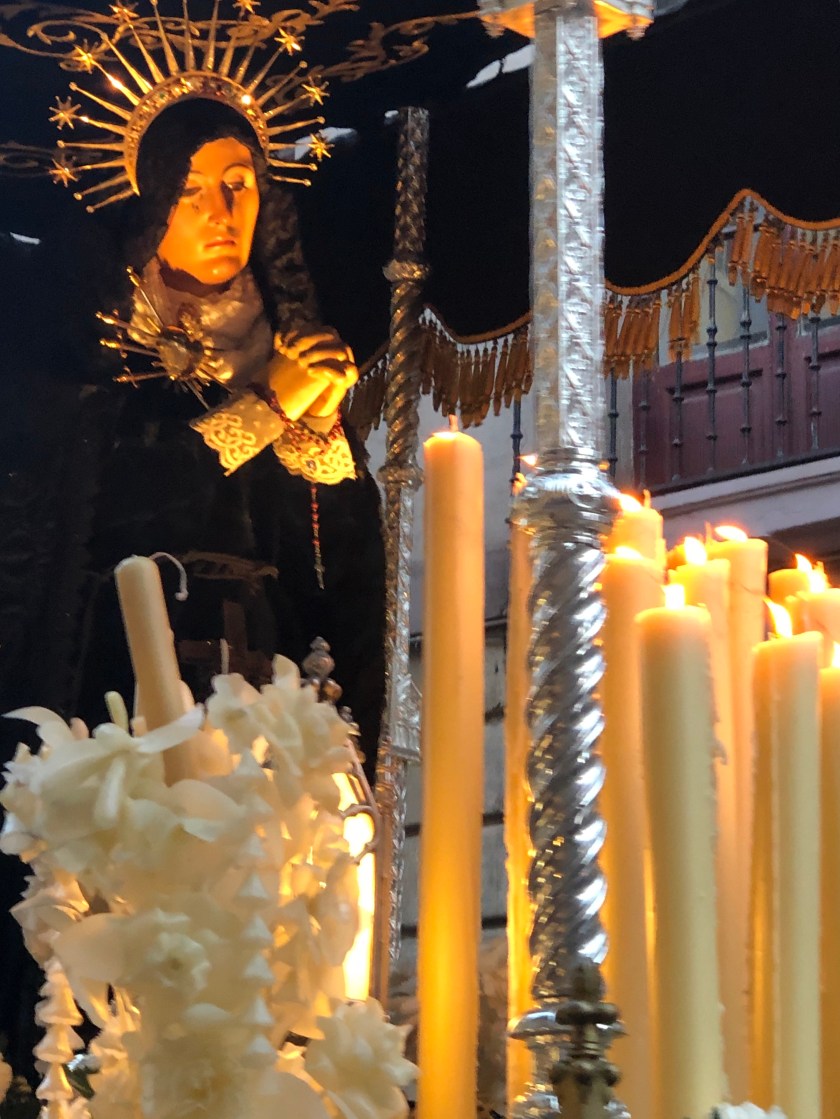
Yesterday the robe was purple; tonight it is sparkling white and gold.

The head that once was crowned with thorns is crowned with glory now.

I go off into the night, back up the hill to my hotel.

The grocery store is still open but I don’t go in.

Mick was right. Tonight I got what I needed and it wasn’t a chocolate bunny.

The Lord is Risen indeed.

Semana Santa- Good Friday

Semana Santa or Holy Week has a long history in Spain. It dates back to the 16th century when Spanish pilgrims returning from Jerusalem began their own version of the Stations of the Cross.

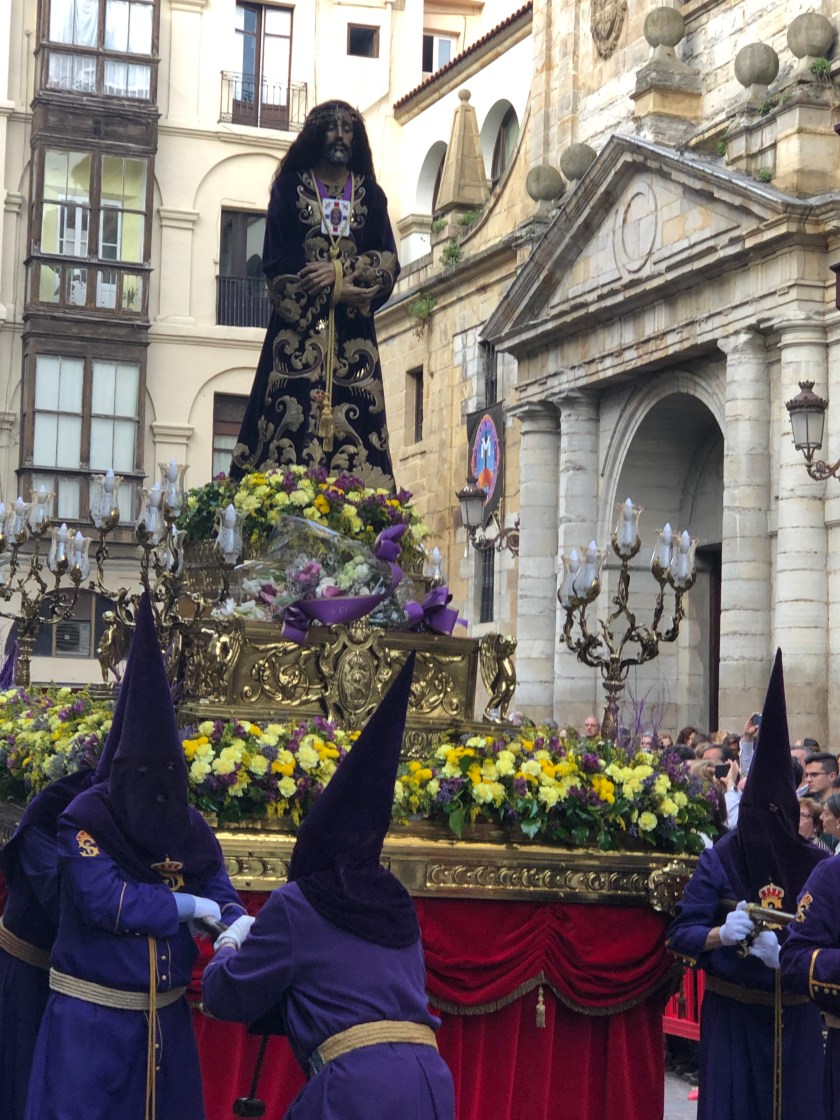
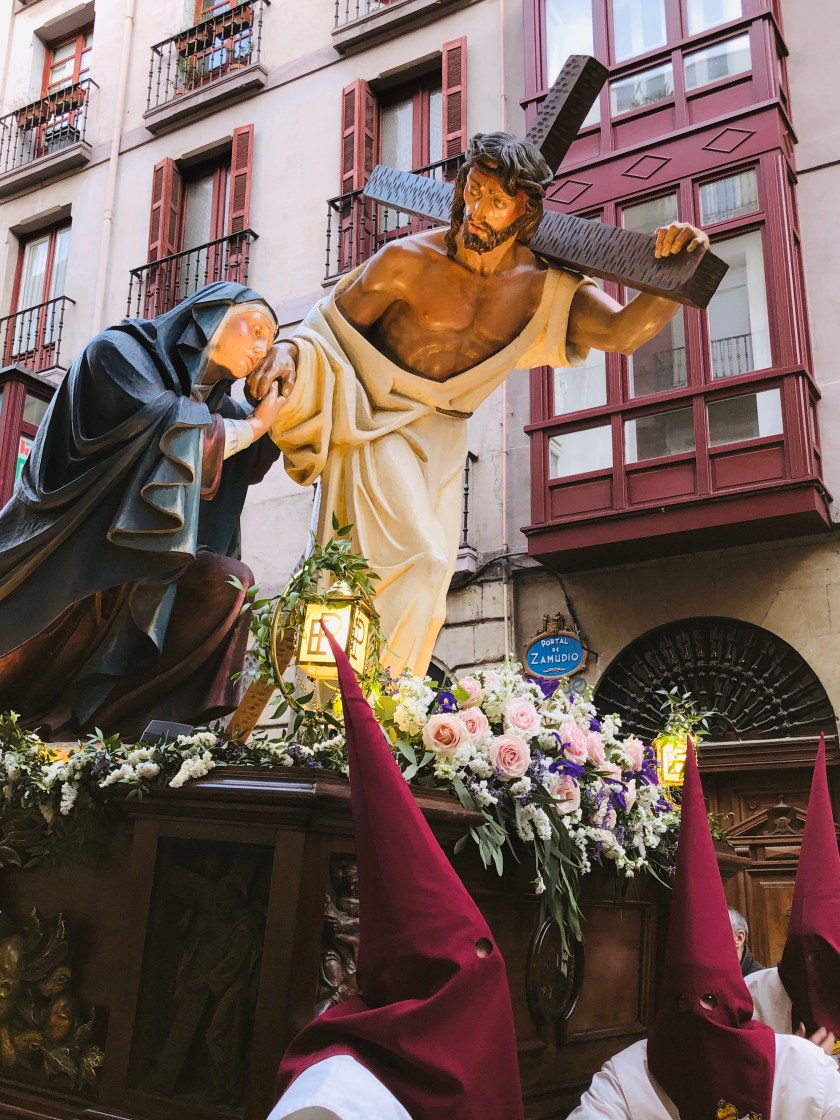
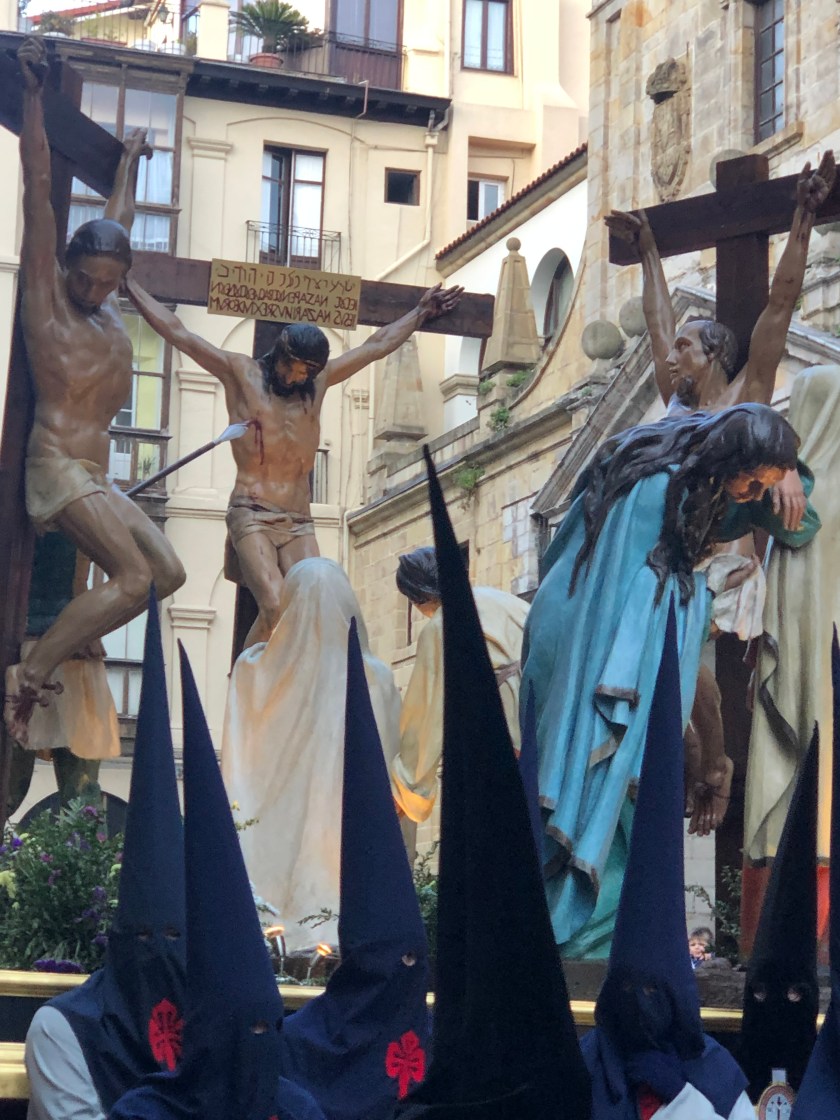
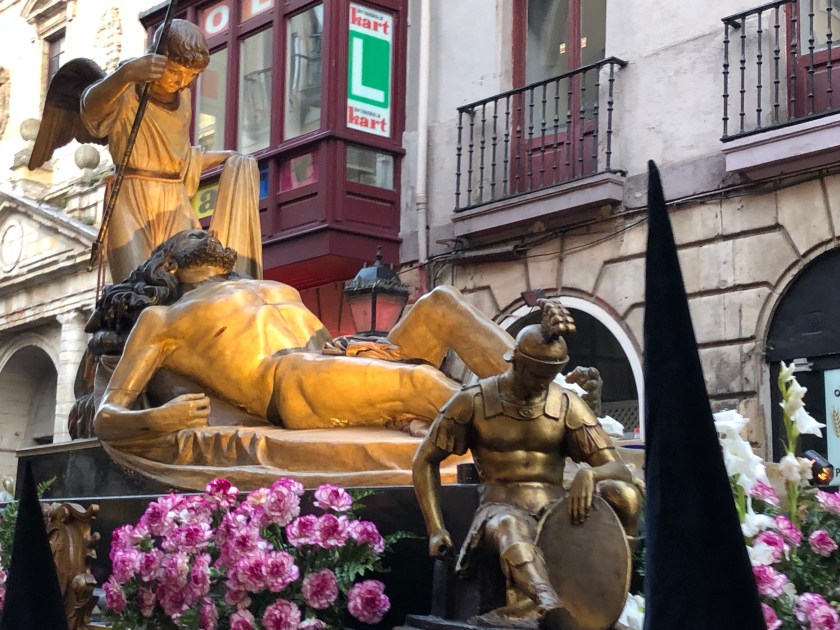
Malaga and Sevilla are most famous for their Holy Week Processions. The floats or “pasos” are huge and elaborate with much gold and silver and masses of flowers. Many of the statutes are hundreds of years old.

One of the benefits of walking the camino in the Spring is the opportunity to observe Holy Week in Spain.

If you are planning to walk the Via de La Plata from Sevilla to Santiago, beginning your pilgrimage in Sevilla during Holy Week would be a perfect start.

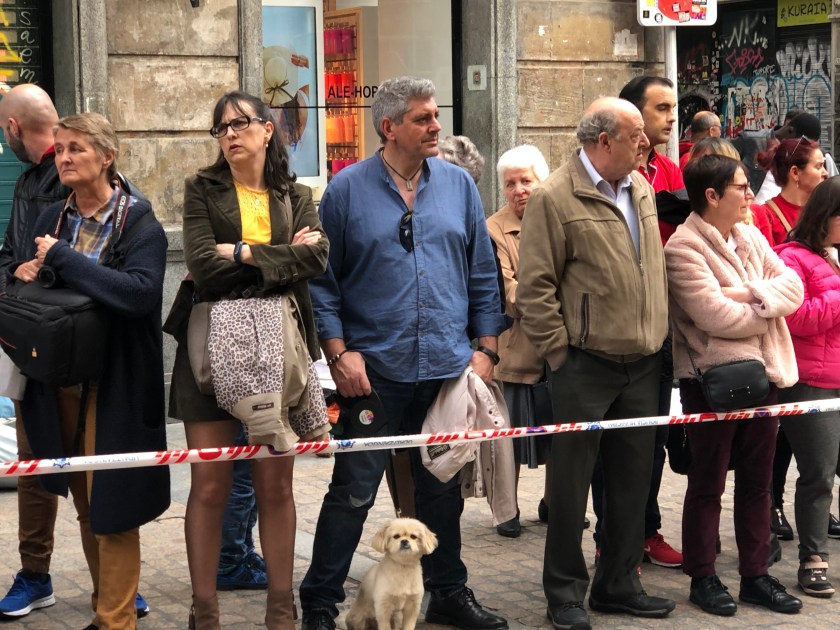
The city turns out in its most solemn and finest and the floats carried by teams of strong young men are awesome.

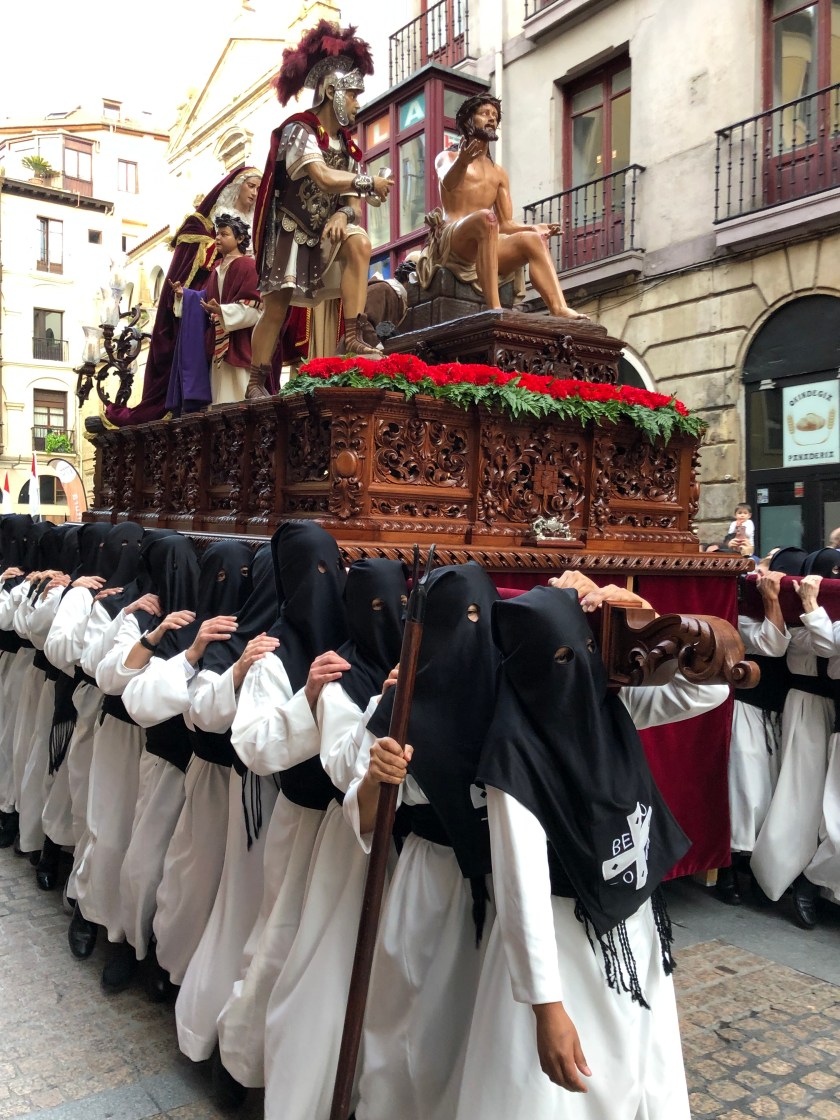
The men who carry the floats in Sevilla by the way carry them from underneath the float so all you see are these huge floats rocking along the street as if by magic.

I have been in Spain to observe Holy Week on four different Camino routes. Each was different. Some were in large cities; others were in tiny villages. Each was equally as moving.

This year in Bilbao was no exception.

The crowds may have been smaller and the dress more casual but liturgical sequence was the same.

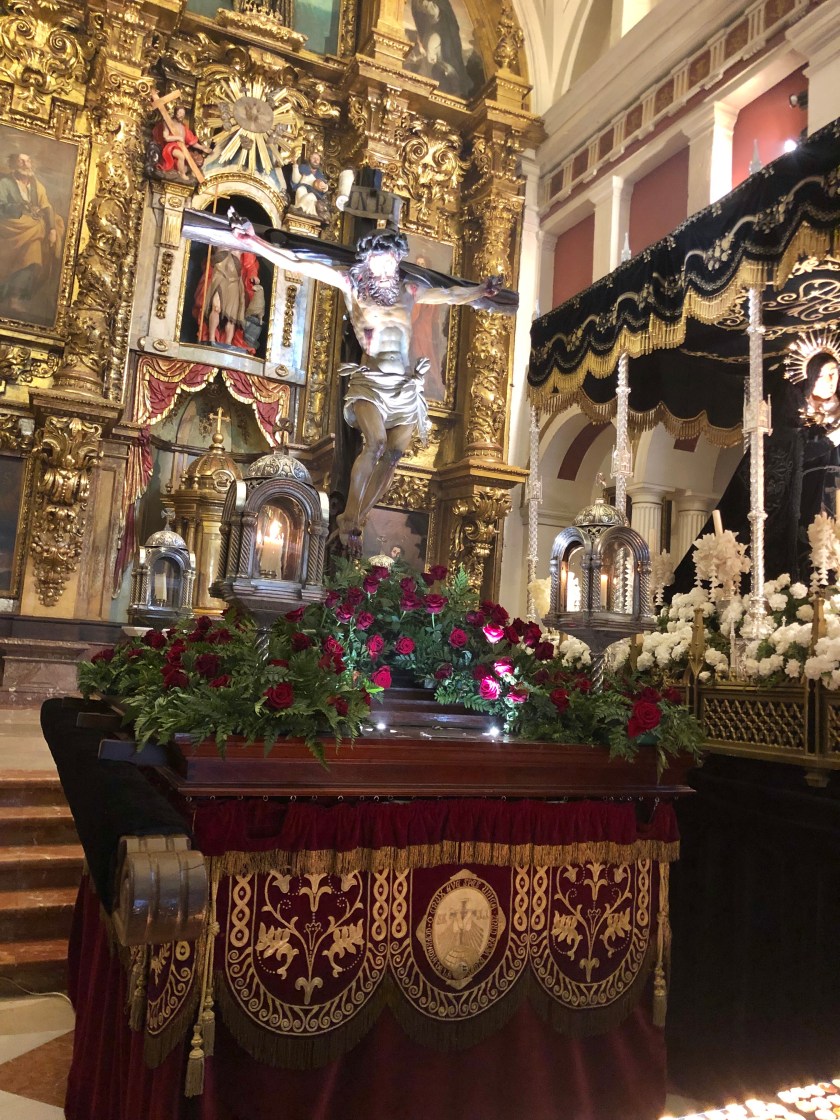
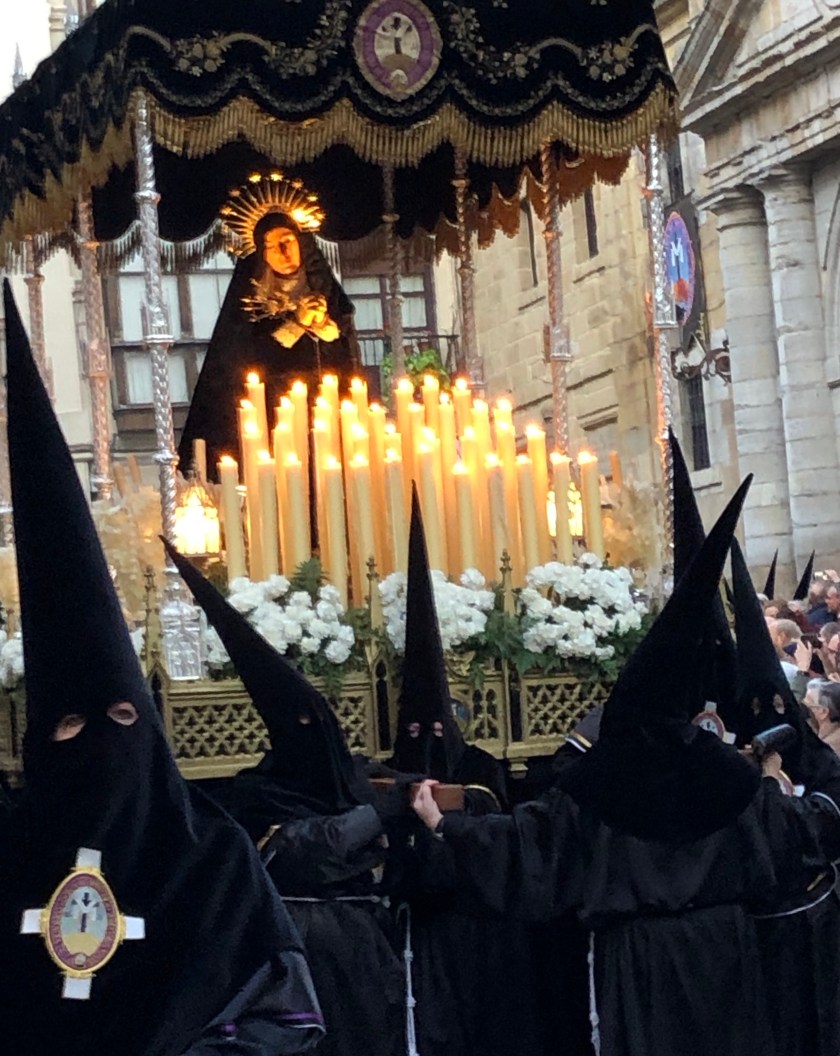
The floats are decorated inside the church.

and carried out to the street by members of the parish fraternity or guild.

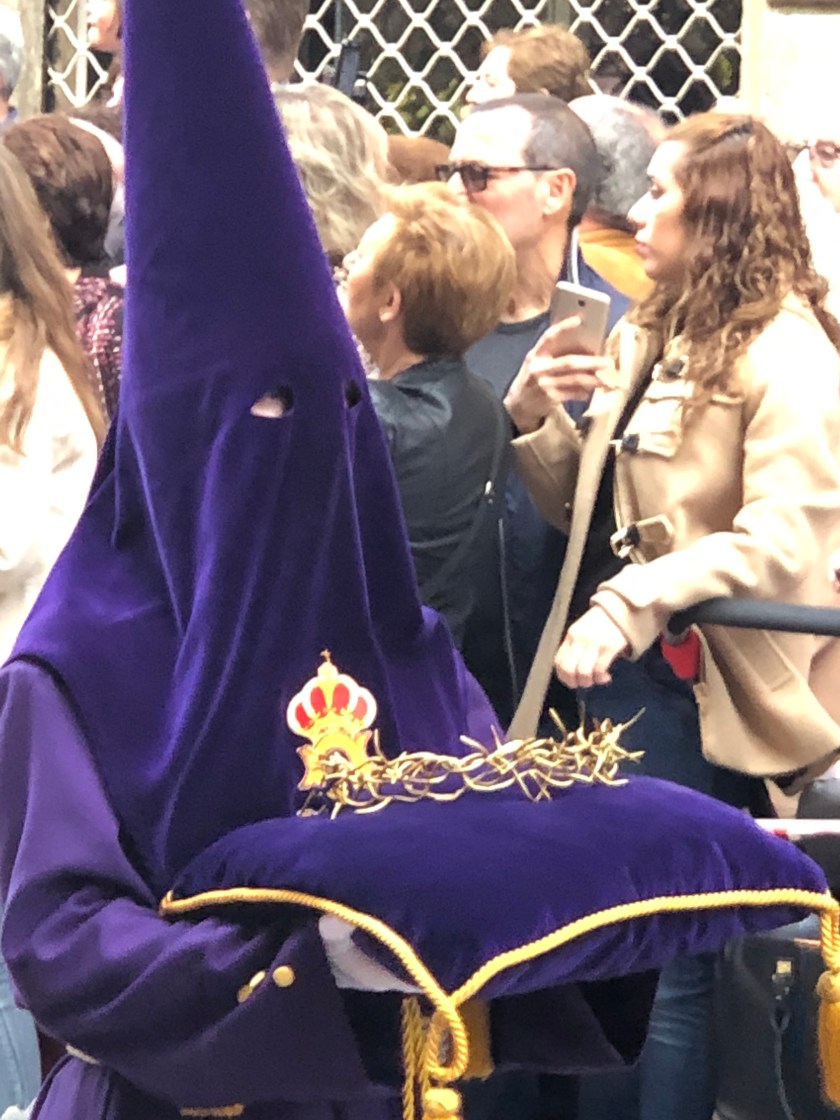
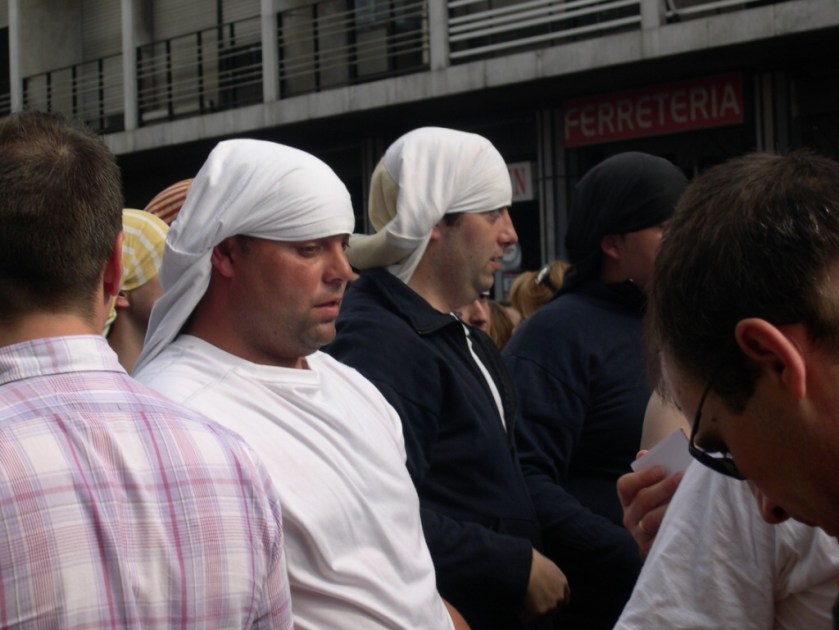
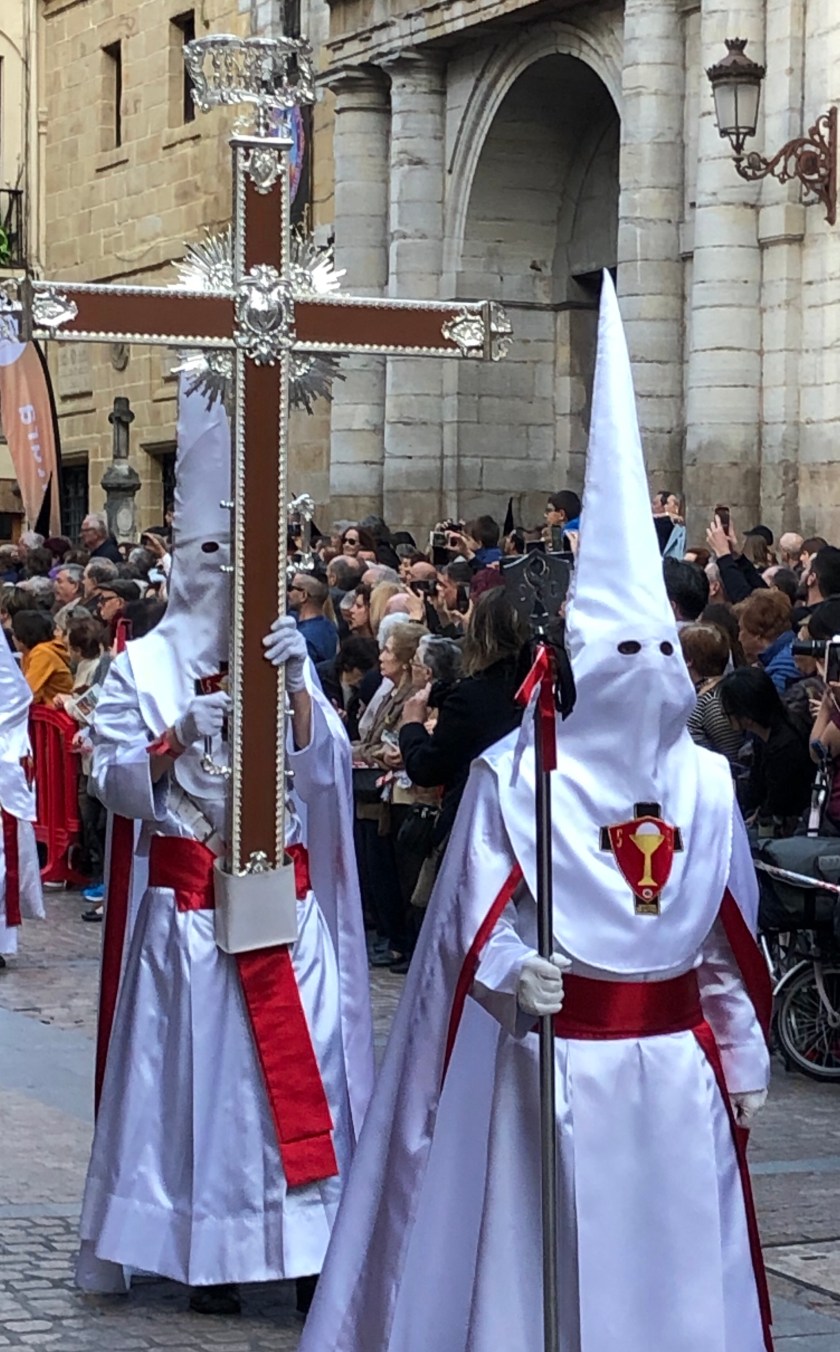
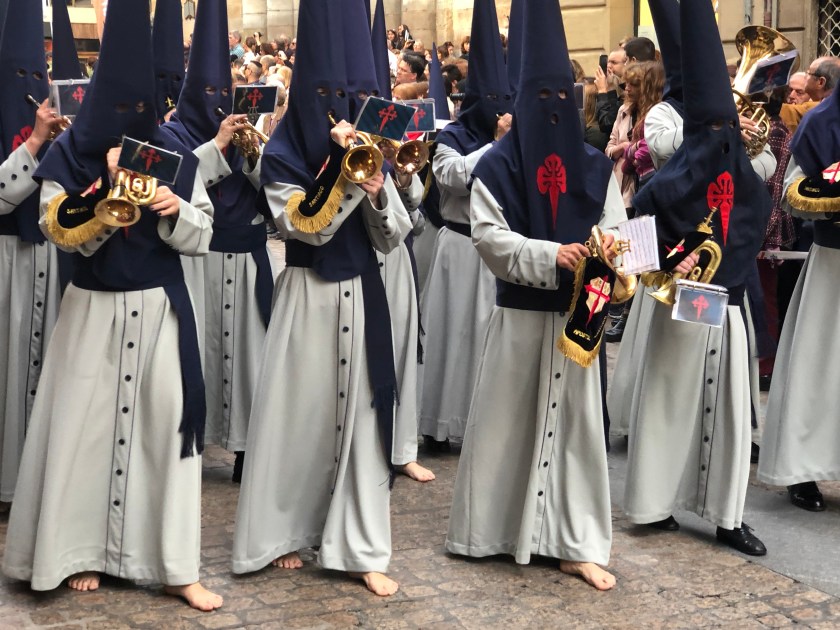
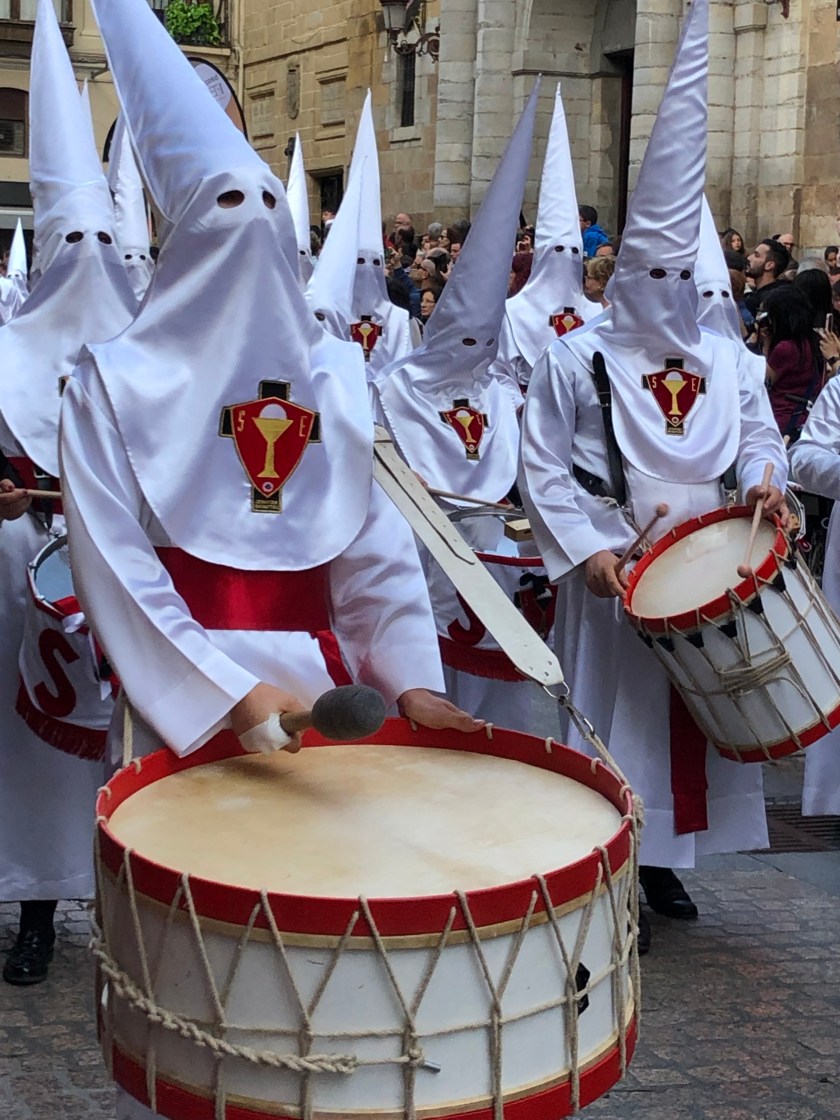
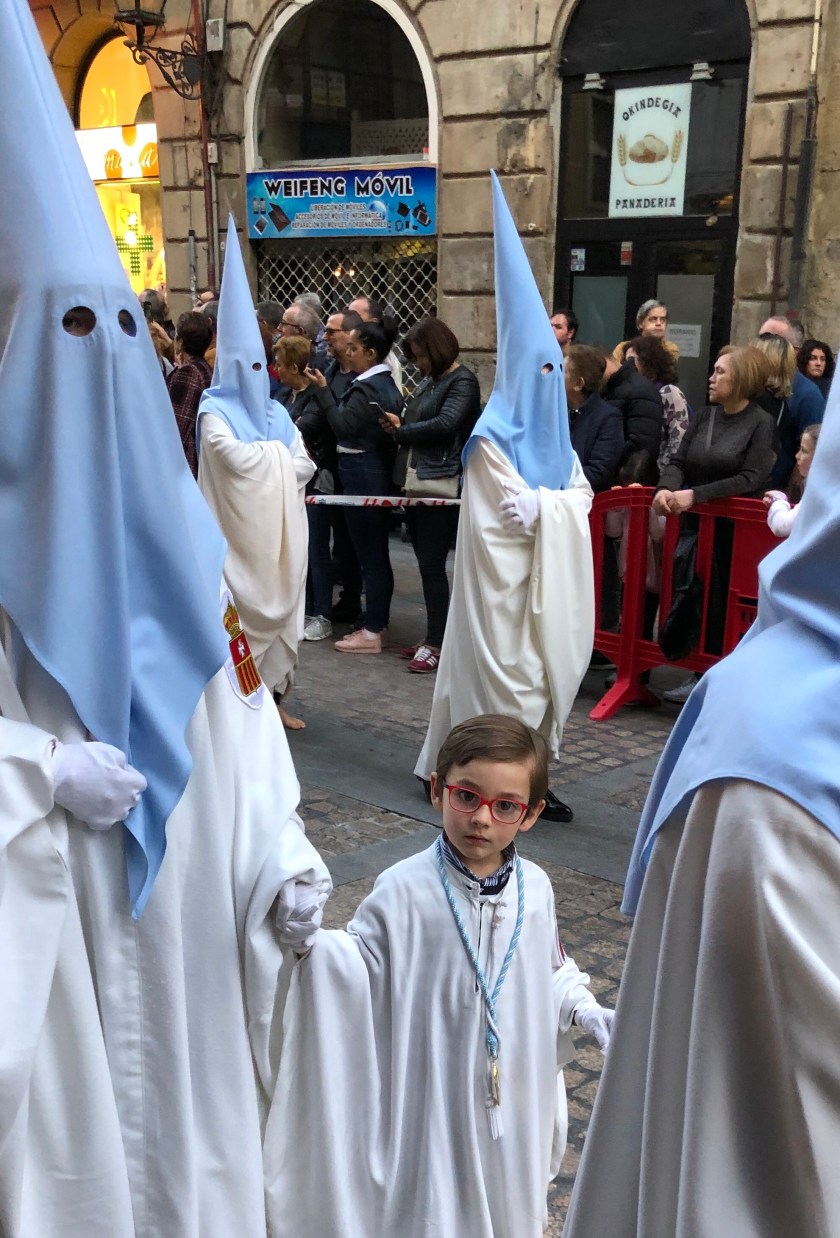
Each parish or fraternity dresses in a different robe and headpiece known as a capirotes .

Unlike the Ku Klux Klan robes and hoods which are a perversion of this attire, in Spain they are an ancient symbol of humility and penance- all sinners are equal in God’s eyes and he alone knows their sins.

The sequence of each procession is the same although the themes of the individual processions may differ. Tonight, being Good Friday, will depict the Passion.

First comes the cross, then the parish banner followed by members of the fraternity carrying candles.

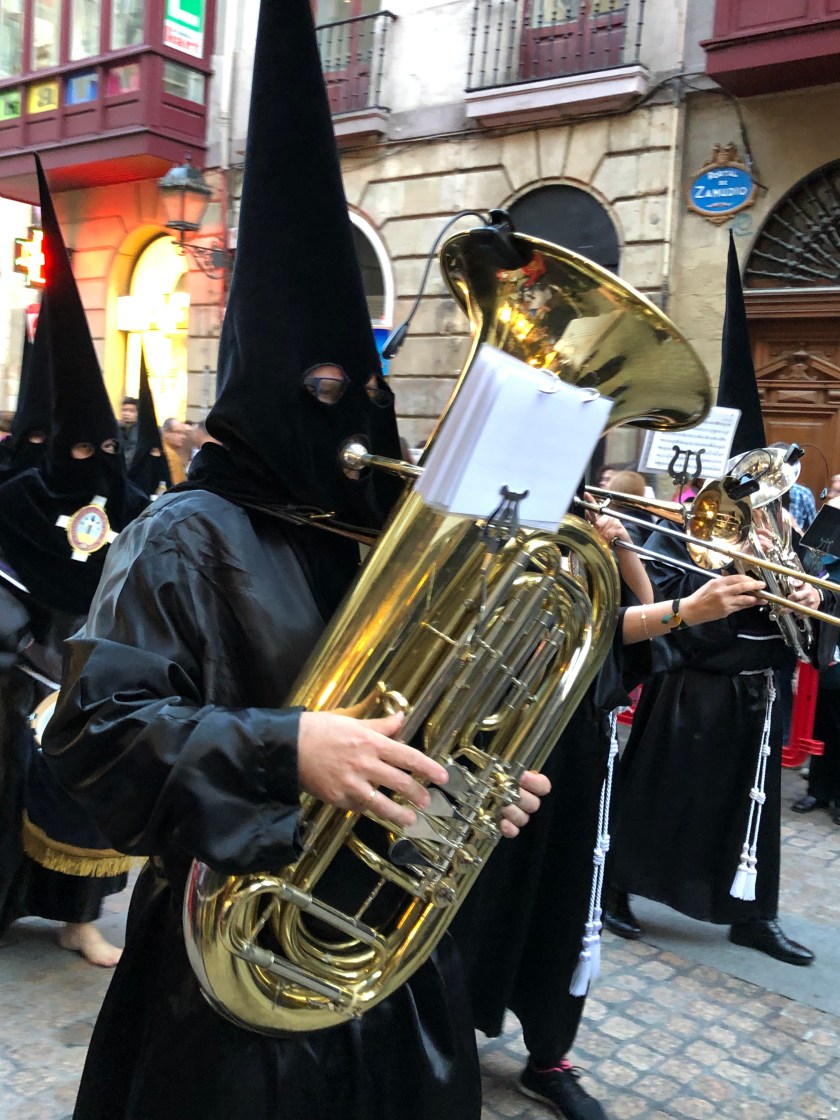
After this come the musicians, all manner of brass and drums. They range from loud to shrill to earsplitting, determined to get your attention for the floats that follow.

Next come the floats, a visual presentation of the passion narrative.

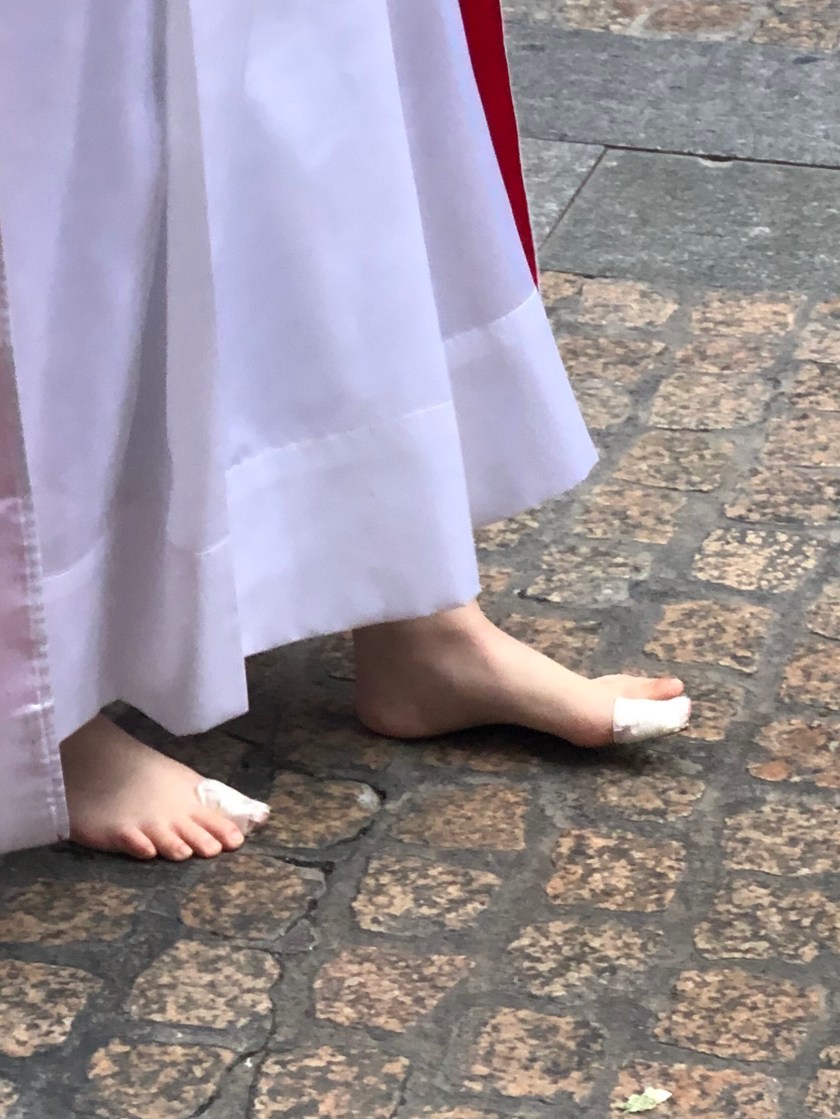
Each float is followed by a group of penitents of all ages, walking in silence -some bare footed, some with chains symbolizing their sins.

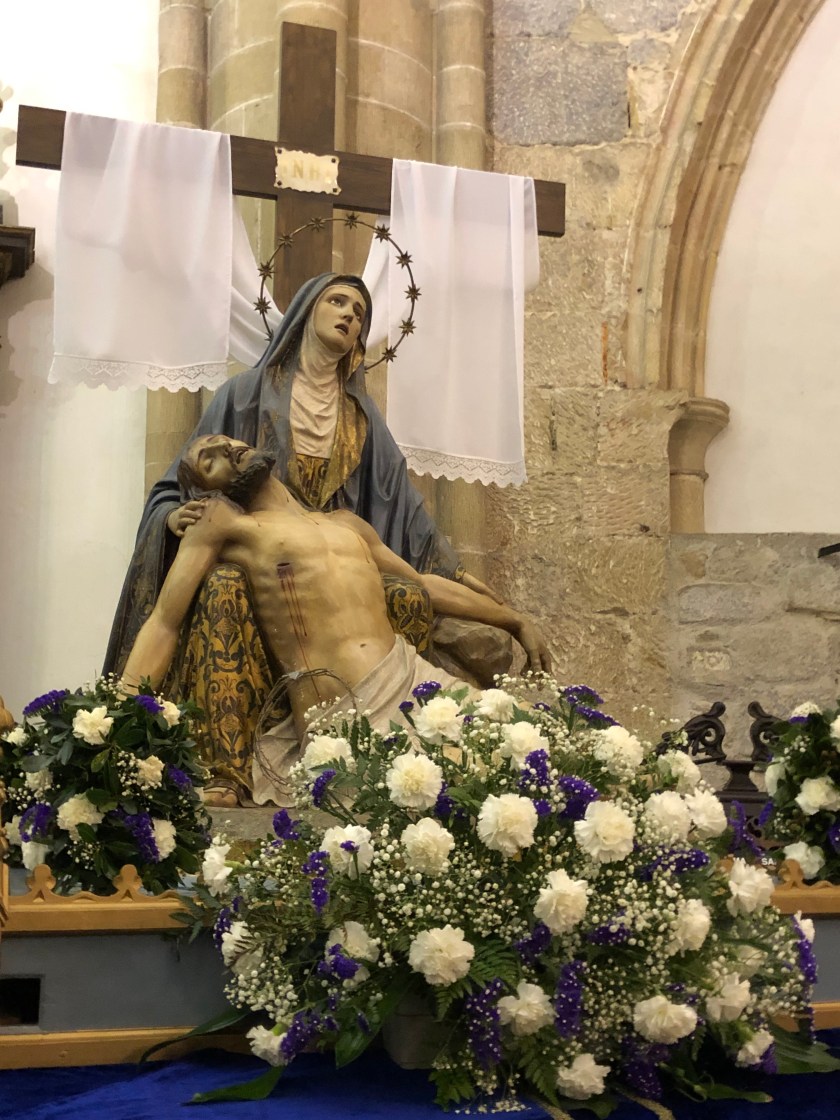
La Dolorosa is the final float- Mary alone with her grief.

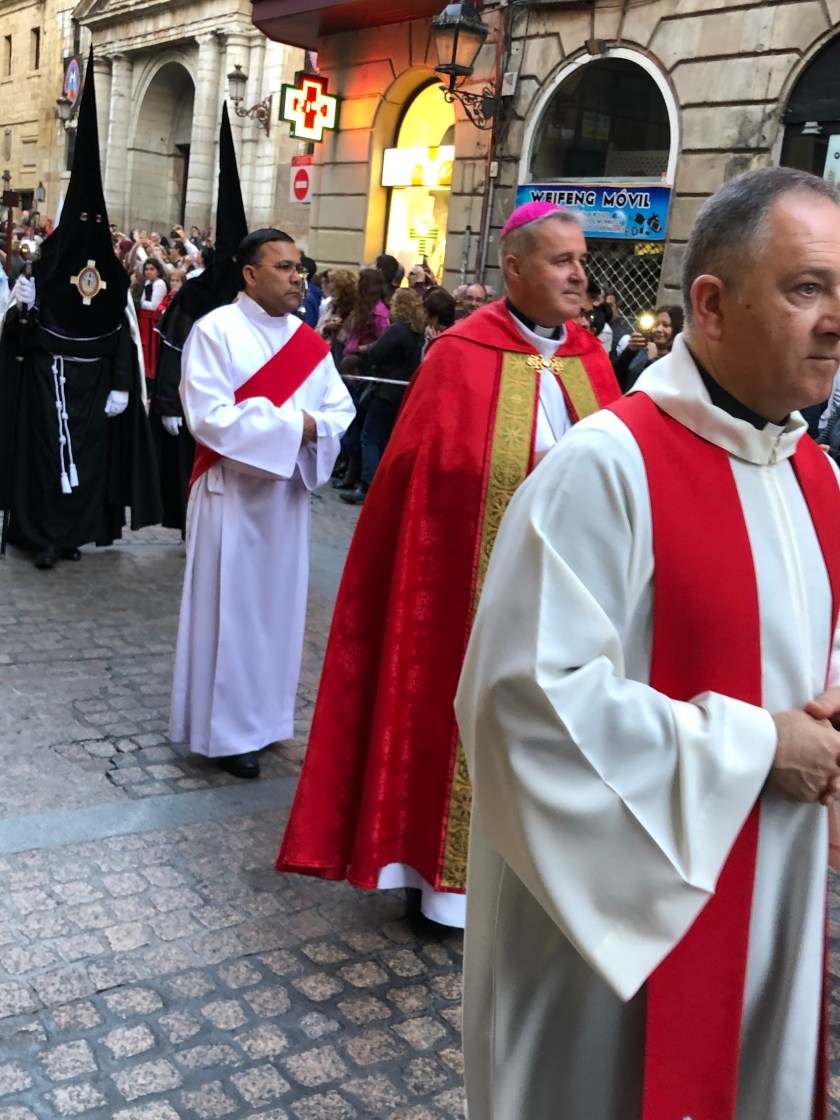
The Bishop and clergy process after her.

One last mournful hymn by the brass, the crowd dissolves into the night, and Good Friday is over for the faithful.

Holy Week- Maundy Thursday

Going to church while walking is a complicated operation.

If you are walking from point A to point B and know it will take six hours, waiting for a church service that begins at 11am is impossible.

Leaving early enough to get to the next town by 11 usually doesn’t work either.

If you’re time it just right on Sunday morning while you are walking through some tiny hamlet, bells will start to ring.

You find the church and walk through the door.

That doesn’t happen often but it has happened three or four times and it’s nice.

Sometimes “church” occurs at unexpected times and in unexpected places.

Last week I struck up a conversation with Grant from Florida and we ended up stopping off the path and saying noon day prayers together.

We leaned against a fence. He leant me a prayer book and followed on his “Common Prayer” App. When the psalms didn’t match we gave up and shared his iPhone. The past met the future.

Our scheduled day for Palm Sunday was a long walk, early start, late church combo. So although I missed church, I did get my palms.
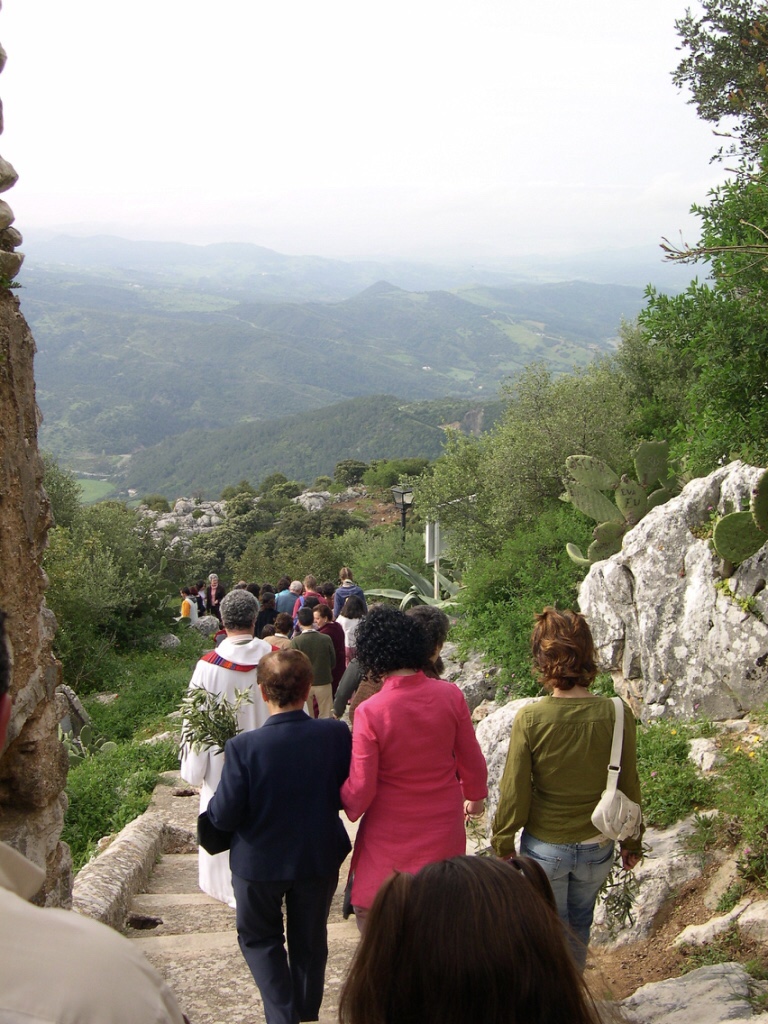
Not “palms to go”from an usher at the door or “drive by palms” Times Square style but close.

I took them from a huge pile in the back of the church the night before Palm Sunday while trying to find out the service times. I took a few leaves. They are still in my pocket. Time will tell if they get through customs.

They look like the same kind of wild shrub we saw several years ago while walking near Ronda.

There, the Palm Procession started in a tiny chapel high up on a hill and processed down through huge cactus to the church.

This year it was palms in the pocket on the path with prayers in my head .

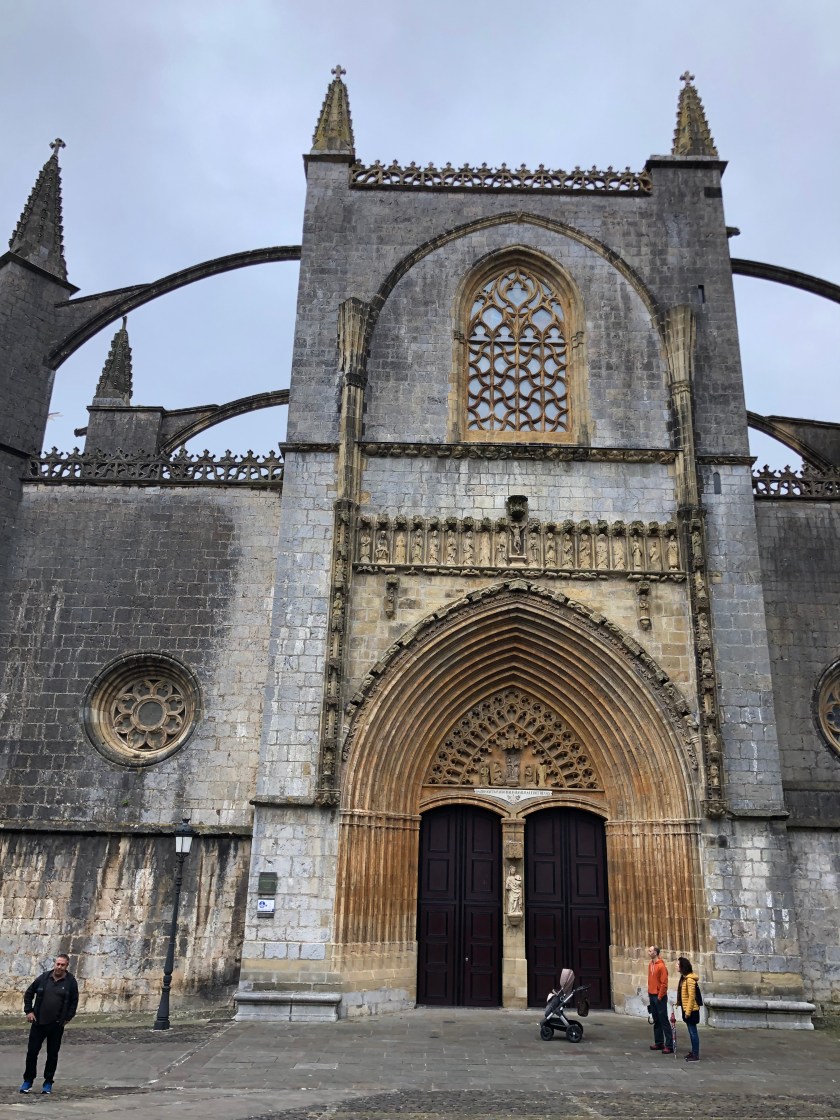
But on Maundy Thursday we were in Lekeitio so I went to this historic church for the evening service.

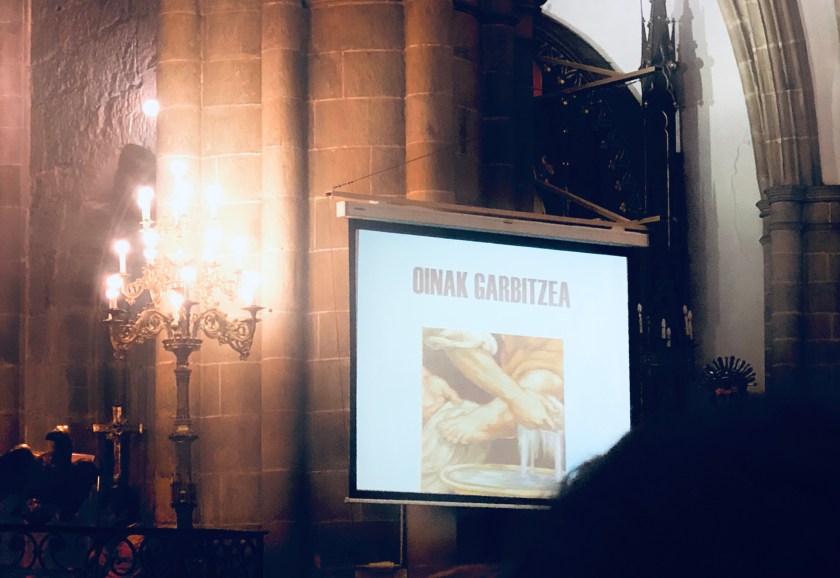
The service was familiar although the basque language was a challenge. I could make out bits and pieces of the liturgy but I was lost in the sermon.

The choir was excellent and the hymns posted on screens on the sides of the church were a great help. The images such as the foot washing and the dove of peace kept me from being totally lost.

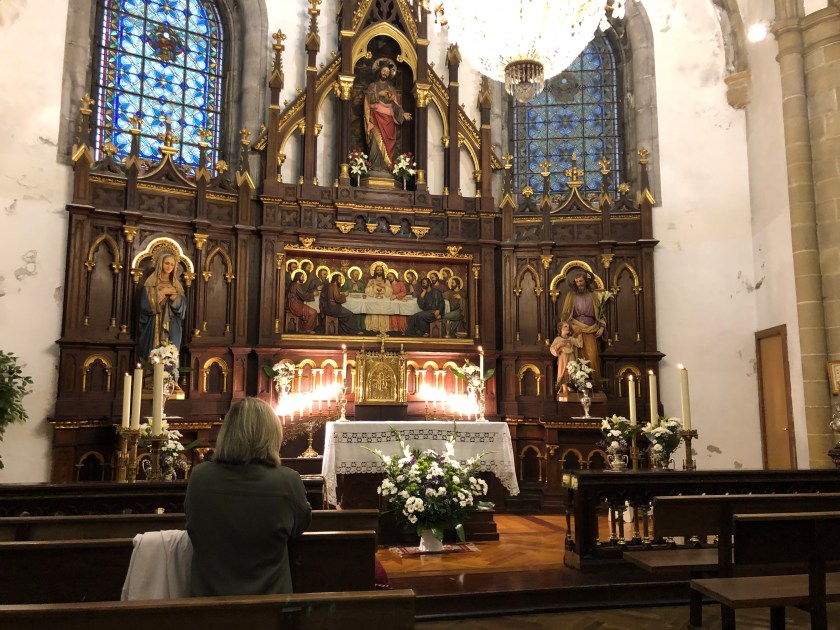
The arrangement in front of the altar of bread and grapes was a perfect image of the Last Supper.

I could not have been in a better place for Maundy Thursday.

After some prayers at the Altar of Repose, I walked out through the dimly lit church.

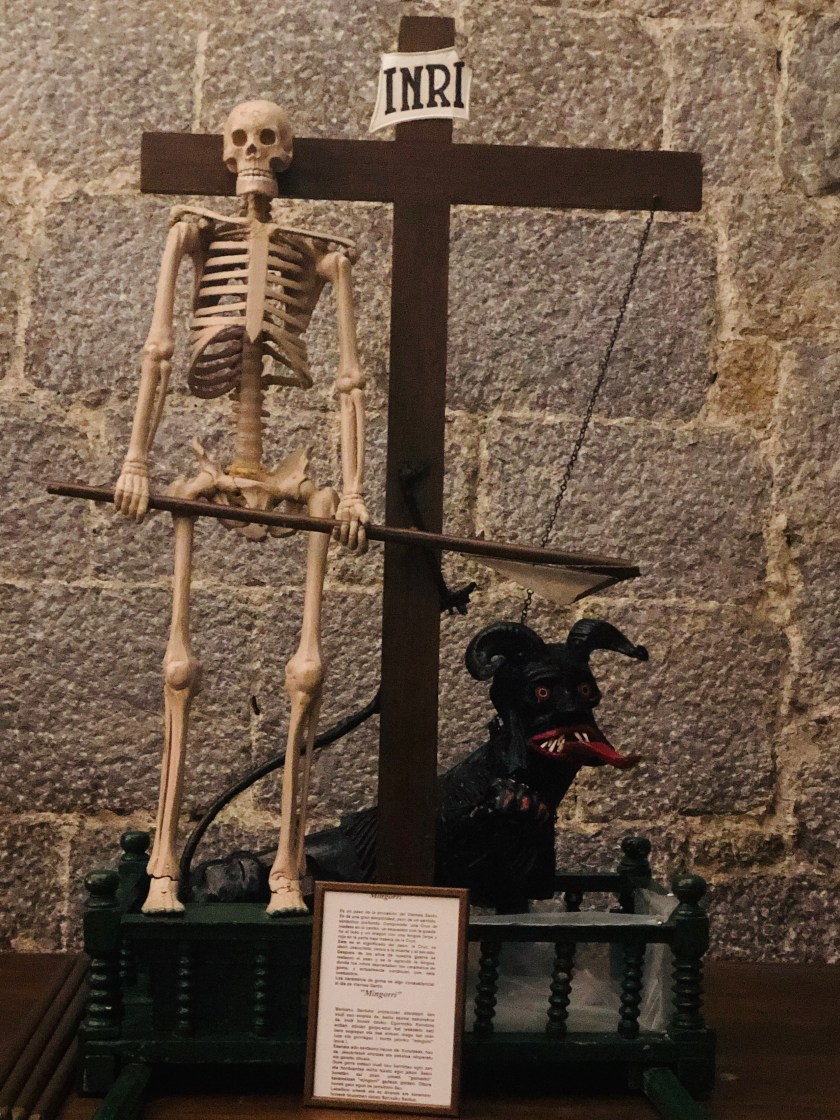
In the silence I was surrounded by the decorated floats depicting the crucifixion. These same floats would be carried through the town on Good Friday, a visual retelling of the Passion.

I leave you with a foretaste of what we would see in Bilbao.

A Soft Landing in Lekeitio

From April 17 -19 we have been in Lekeitio, an important fishing town on the Bay of Biscay with a fine protected harbor and an even better beach.

We came here by bus which is inexpensive and a great way to see the little towns. It also makes the the 40km stretches with no lodging possible.

After scrambling over the rocks with 12 mile days and 200+ “flights of fitbit stairs, a beach looked good and it was.

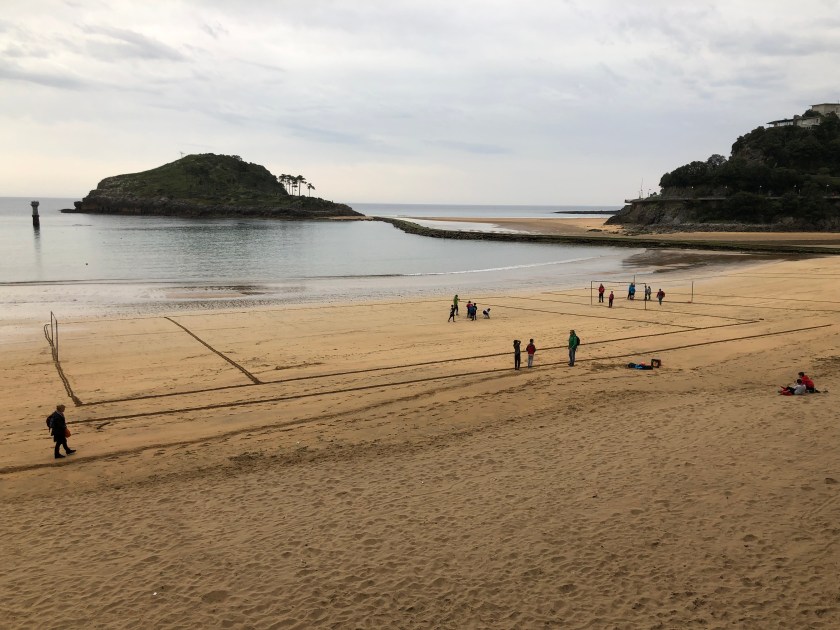
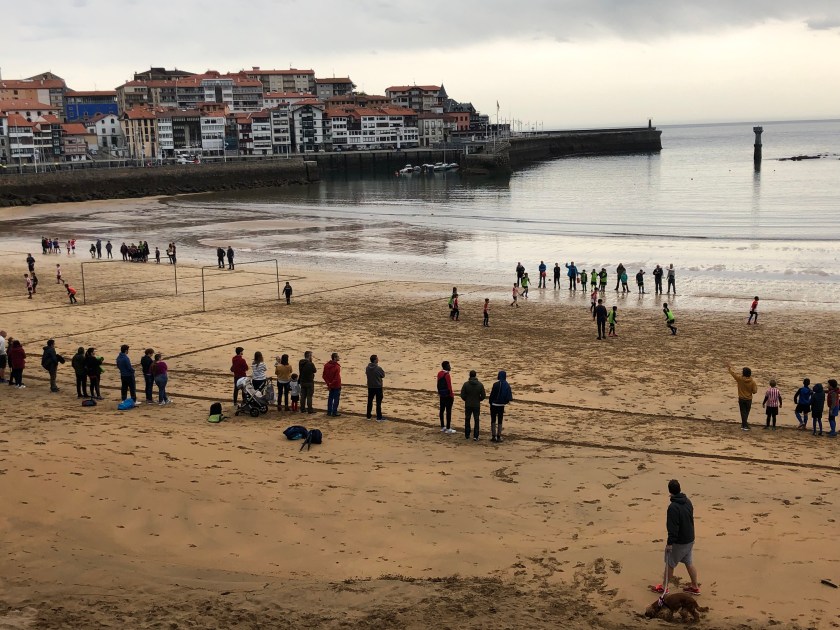
Since it was Holy Week school was closed and families were out in force.

One morning the beach was set up for volleyball. It looked like your typical American Saturday morning with kids, dogs, parents and grandparents on the sidelines.

Rowing teams raced around the harbour . Some crews were kids; others were rowers of every age, all pulling and playing together.

Further down the beach there was a race track and a little car was tearing around with sand flying.

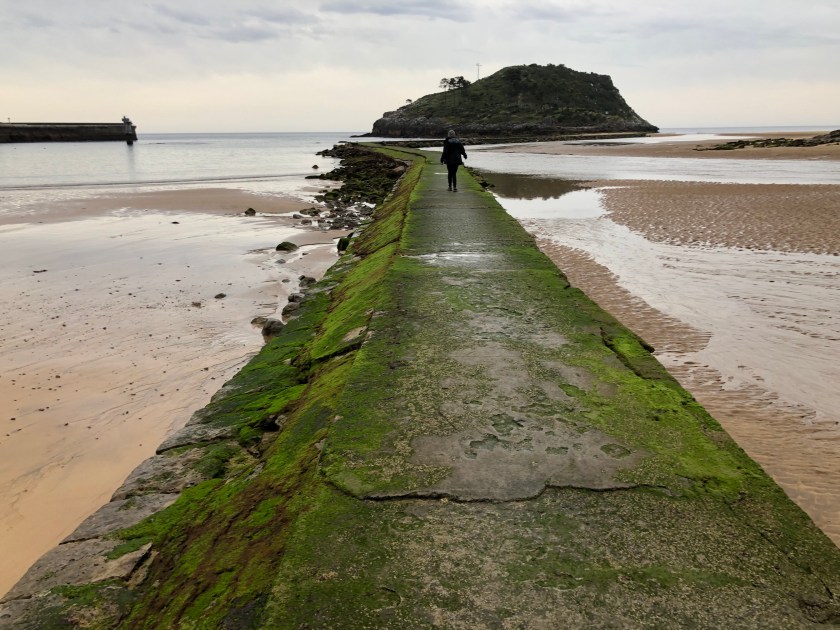
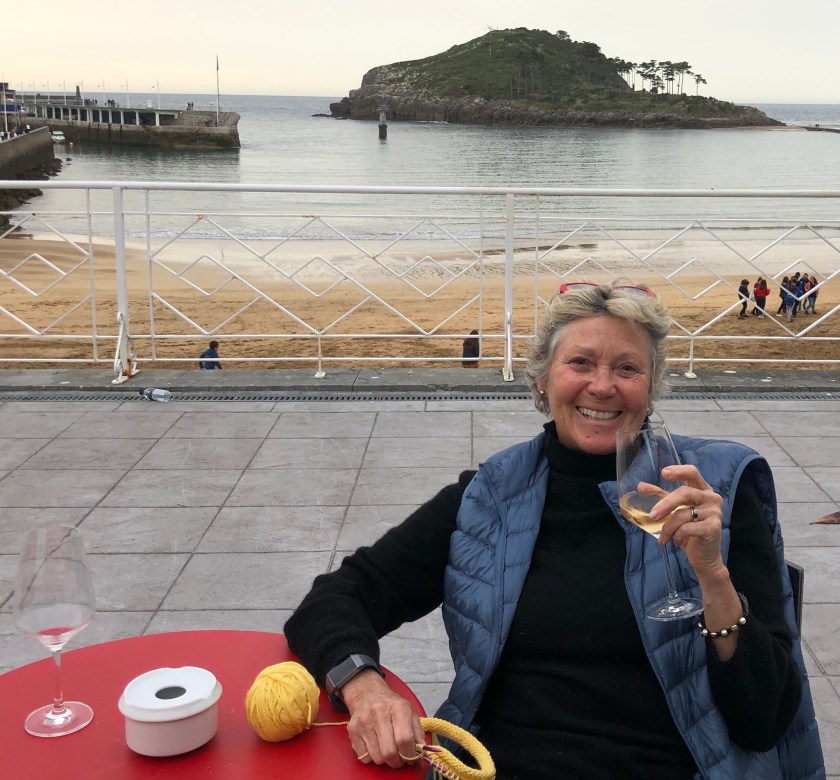
Since the tide was low it was also possible to walk across a seaweedy and slippery causeway to an island off the coast. Barnacles on the concrete kept us from slipping into the sea.

Black crabs were too fast for us but many are caught here and we ate our share .

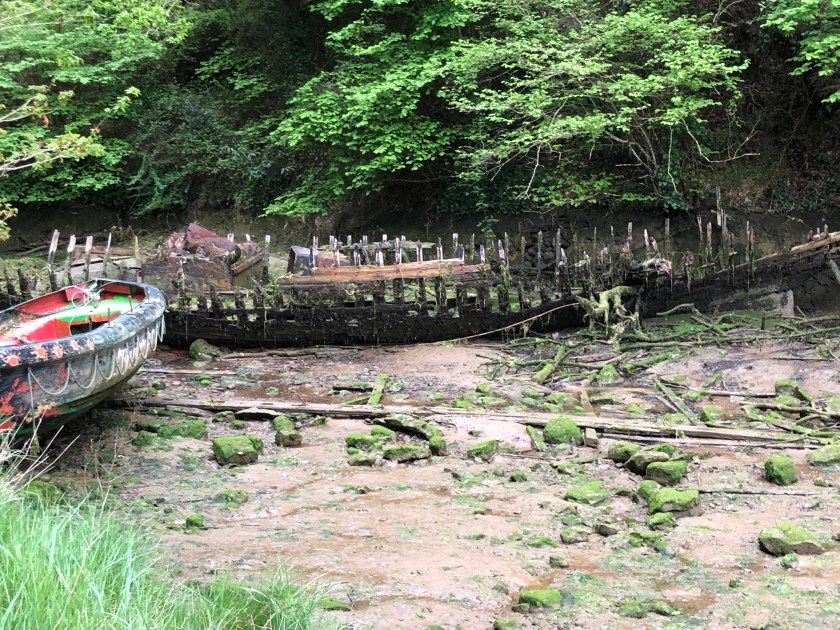
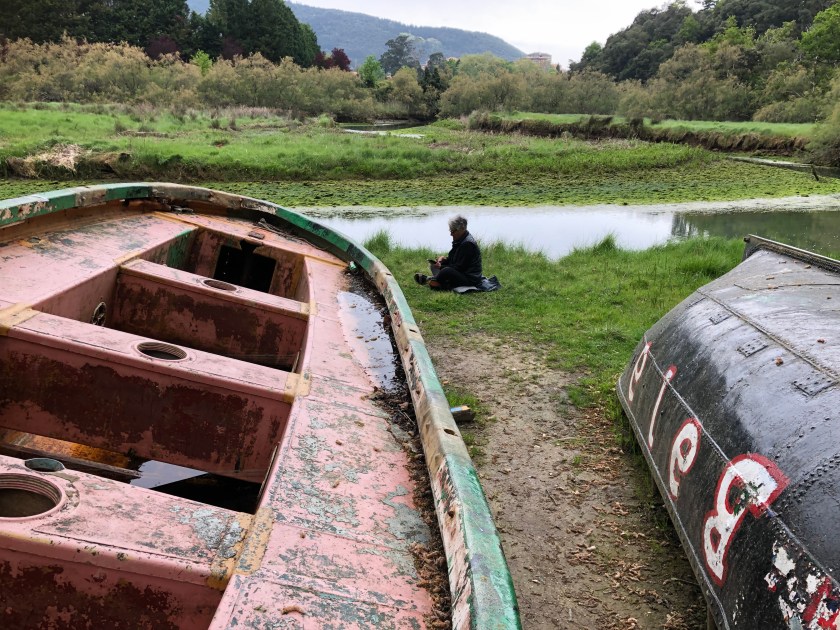
We walked up the river on a local path past long abandoned boat building sheds with rusty railways for launching them.

The path was busy. The young, the old , strollers , dogs runners and us. Everyone was on the move.

And then the tide came in. It was all over. The beach was gone. The people went in. Time for lunch a little wine, a little knitting and a siesta.